Foreword: This project was written for the Dionysus Mythology Course, taught at NoDE, with Fabianzzz as the teacher. I would like to flesh out this discussion more in the future and include citations.
*****
Dionysos and Hephaestus: The Rise of the Working Class The mythic ascension of both Dionysos and Hephaestus to Olympus, and how alcohol tapers the anger of the worker’s revolution and births democracy.
In the 12th century BCE, the highly advanced late Bronze Age civilisations around the Aegean collapsed into a dark age. International trade ceased, empires fell, and history was lost. We don’t know the cause of this collapse but what resulted was the upheaval of the social structures of the Bronze Age. What was once numerous citadels controlled by warlords was laid waste to a diaspora of simple people. From the literal ashes of empires, a new structure of civilisation began to flourish, Democracy. Not kings, or tyrants, but average citizens, including the working class, were given the power to rule.
During the slow formation of the Classical Era after the Dark Age, myths began to be recorded of a lame, crippled, physically disabled god being born by the rulers of Olympus, Hephaestus. His deformity or ugliness was unfitting for the lofty clouds of heaven, and he was discarded by the gods. Falling to earth a reject. This grounding was formative for Hephaestus as necessity required him to be inventive, crafting a wheelchair and learning the art of metallurgy. As he advanced in his skill, he devised a plan to seek revenge on his parents, a gift. One of many gifts of Hephaestus that was cursed. This gift was a golden throne for his mother, Hera, its splendour, and beauty was such that it was irresistible. When the crafts god presented the throne to her, she did exactly what he expected her to do, sit upon it…and when she did Hera found herself stuck.
All the gods tried to remove her from her seat, but no power in the cosmos could lift Hera from her throne except Hephaestus, who refused to do so.
Elsewhere on earth was a wandering god, a god of wine, passion, and freedom, Dionysos. This god once driven mad by Hera and cursed to travel forever to avoid her wrath, heard the story of his stepmother being trapped. One can assume that Dionysos delighted in her fate, but we also know he saw it as an opportunity to cease his wandering. Dionysos met with Hephaestus at his forge and introduced him to his sacred liquid, wine. Hephaestus experienced joy, happiness, and slow stupor as he drank the juice of Ampelos, and Dionysos took the opportunity to prop the drunken cripple on an ass and take him to Olympus. It was here, in front of all the heavenly gods – including the distressed Hera – that the god of liberty made his offer for the queen’s freedom. Accept both himself and Hephaestus into Olympus or be forever trapped.
Hera could not refuse, and Dionysos convinced Hephaestus to free her. Thus, the two gods elevated to the heights of heaven.
Dionysos (centre) bringing Hephaestus (left) to Hera (right) Copyright theoi.com Attic red-figure pelike, 440–430 BC
*****
This myth, like all Greek myths, has variations and different outcomes, though typically Hephaestus is married to Aphrodite and Dionysos becomes the life of the party on Olympus. Though what can it tell us of the social changes in history and why is it necessary for a craft god and wine god to enter the rulering sphere of Olympus?
It is a fact that ancient cultures depended on slavery to progress in development but in the previous century archaeological discoveries in Egypt have determined that the dependence of slavery was not as widespread as mentioned in Biblical telling. The quality of the lifestyle of the Pyramid labourers indicates that these monuments were not entirely built by slaves, but rather by free workers, citizens of Egypt. They were granted lodging, food and beer in wages and even had a system of free healthcare and funeral rites. Later in Athens, workers took great pride in their craft to the point it became a defining feature of their cultural ethos. The Greeks were amongst the first individual artists to sign off on their work. Pottery often features “I was painted by (artist name)”. This elevated craftsmen to positions of status in both social situations, and in terms of celebrity fame. Individual artists were commissioned by kings and political leaders, often becoming advisers, and friends to the ruling elite and even living in palaces. The Greeks saw the labourer as something more than a lowly peasant, underserving of the presence of the king, to a high-ranking member of the court/democratic council of leaders.
It is in the myth of Hephaestus that we see this change of social status develop, as the greatest of craftsmen, the god of craft becomes an Olympian. But what of Dionysos? What’s his role in this myth?
“Wine cheers the sad, revives the old, inspires the young, makes weariness forget his toil.” Lord Byron.
Already mentioned was that the Egyptians used alcohol as a commodity, but in Greece, wine was given to all. On Dionysian holidays wine was freely distributed even amongst slaves and prisoners, wine and mead being the choice drink of the working class. It enabled them to be free from the stress, pain, and displeasure of labour. It also gave the people a form of expression. As Kerenyi mentions comedy was likely the first form of performance art, a drunken farce or open mockery of noble/public officials. Wine empowered the working class to not just mock the elite, but to stand up against them. Wine, the passionate equaliser, has spurred many a revolution…but also it has quelled them, as with the Hephaestus myth, wine is used to subdue the working class and to prevent revolt.
In later times, in Rome, the link between the working class and Dionysos and Hephaestus continued. Hephaestus’ Roman equivalent Vulcan had twins called the Palici, (Palikoi), the cult of the Palikos was one of the only examples of an emancipation cult, dedicated to freeing slaves and giving refuge to those who escaped their masters. Meanwhile, Liber (Dionysos) was called upon by the Proletariat and often associated with the legal freeing of slaves.
So, if we look at this interpretation of Hephaestus’ myth, he can be seen as the working class revolting against the ruling elite, rising against to it to the point they are immobilised in their place of status, but unable to rule. We see this in revolutions, like the French, where women’s marches essentially besieged and imprisoned the Royal family and aristocracy in the Palace of Versailles. Hephaestus does the same to Hera. Dionysos acts as the negotiator but at the same time, he demands equal rights to the elite (Olympians), thus establishing Democracy, equality and labour rights.
Horns Magazine is a gay-focused, LGBTQIA+ pagan/occult magazine. It features different voices from our various communities and includes beautiful homoerotic images (obviously NSFW and 18+).
I write for Horns Magazine, covering the history of LGBTQIA+ deities and spirits from ancient and contemporary paganism and other religions. In previous issues I have written about Dionysus, Shiva and Santa Muerte.
In Issue #10 I have written about the Gay Rabbit god, Tu’er Shen from China and Taiwan.
The issue has been published digitally but will be available for physical print in the near future.
Foreword: This project was written for the Dionysus Philosophy Course taught at NoDE, with Fabianzzz as the teacher. The intention is to explore philosophical concepts from elsewhere and see how they compare with Dionysian philosophy.
*****
Comparative mythology reveals striking parallels between Shiva and Dionysus. Both are portrayed as outsiders, wanderers, and phallic deities that defy social norms and expectations. (1) Each governs the realms of life and death, serving as a cosmic force underlying all aspects of existence. In Tantric Shaivism, a particular philosophy of dualism emerges, categorised by gender as feminine and masculine—known as Shiv-Shakti, or Ardhanarishvara. (2) Shiva represents the masculine: the external, immaterial, and abstract consciousness, the essence of divinity. Meanwhile, his consort Shakti embodies the material force that brings abstraction into reality, she is the energy and matter of all. Shiva symbolises destruction and the impermanence of all things, while Shakti is the creative force that manifests material existence. Separately, these forces are inert, lifeless. Together, in union, they form the cosmos. (3)
While the duality of Dionysus and Ariadne is less apparent in antiquity, we do see Dionysus as a philosophical god and a soul saviour, these ideas were present in the early classical but became more prominent in the latter period of antiquity especially amongst Neoplatonists. More importantly for this project is pointing out that Dionysus is represented as a cosmic force, Zoe, eternal life. Zoe is the pervading essence of all life, Anima Mundi – the world soul. This is in opposition to Bios, mortal or rotting life. (4)
The aim of this project is to explore these concepts and highlight the similarities between Shiv-Shakti and Dionysus-Ariadne and the possibility of dualism in Dionysism by comparing these ideas and myths.
Mythology: Shiva falling in love with Parvati
Shiva’s first wife was Sati, a form of Shakti. On their wedding night, Sati’s parents insulted Shiva, and in protest, she set herself on fire, perishing in the flames. Grief-stricken, Shiva retreated into solitude, withdrawing to Mount Kailash, where he remained in deep meditation. Neglecting his duties as the destroyer, he caused the universe to stagnate, and deathless demons threatened the heavens.
Noticing the imbalance, Brahma turned to Shakti for help. She took the form of Parvati, intending to marry Shiva and restore cosmic order. Reborn as the mortal child of the Himalayan gods, her name means “of the mountains.” Raised in a palace by loving and protective parents, Parvati grew up surrounded by beauty and privilege. Yet, during her travels through the Himalayas, she encountered Shiva in meditation and became captivated by him. Despite her attempts, she could not stir his attention. Determined, she chose a path of devotion, dedicating herself to him through strict penance and servitude.
As Parvati deepened her spiritual practice, her radiance spread throughout the cosmos. The gods, recognising her devotion, sent Kama, the god of love and pleasure, to break Shiva’s meditation. While Parvati attended him, Kama shot his arrow, successfully awakening desire in Shiva. However, realising the deception, Shiva opened his third eye, utterly destroying Kama and erasing all love and desire from the universe.
With her hopes of marriage seemingly lost, Parvati did not waver. Instead of seeking to rouse Shiva, she intensified her ascetic practices, undertaking even harsher penance for thousands of years. Through this, she gradually attained spiritual enlightenment equal to Shiva’s own. Her presence became undeniable, even to Shiva himself. Drawn by her power and devotion, he finally emerged from his meditation and sought her out—falling in love at last.
With Kama restored, Shiva and Parvati consummated their union, realigning the cosmos and manifesting as Ardhanarishvara—the supreme, unified being. A divine embodiment of destruction and creation, they exist eternally in perfect balance. (5)
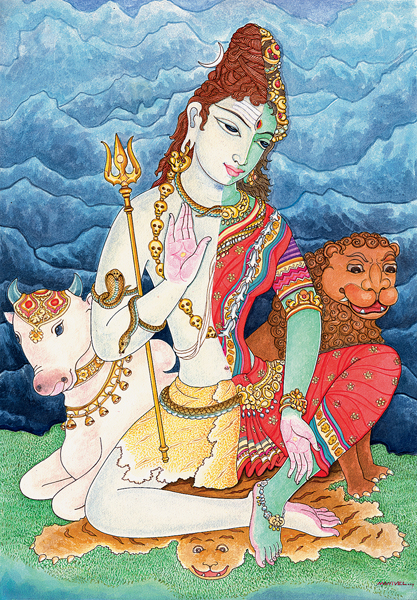
Ardhanarishvara (अर्धनारीश्वर): Shiva is represented pale skin (their right), Shakti green skin (their left). Copyrighted to Himalayan Academy Publications, Kapaa, Kauai, Hawaii. (CC-attribution)
The myth of Dionysus and Ariadne
Ariadne was born the princess of Crete, daughter of Minos and Pasiphaë (a sorceress), sister of the Minotaur. The hero and future king of Athens, Theseus, embarks on a quest to end the cruel tribute Athens must pay to Crete every seven years—a sacrifice of human lives to the Minotaur, imprisoned within the labyrinth. Disguising himself among the sacrificial victims, he infiltrates the city of Knossos. There, Princess Ariadne sees him and falls in love. Moved by her feelings, she agrees to help him. She provides Theseus with a sword to slay the Minotaur and a ball of thread to navigate the labyrinth’s twisting passages. With her aid, he succeeds in his mission, and together, they flee Crete by ship. There are different variations to this myth, but for whatever reason, Theseus abandons Ariadne on the uninhabited island of Naxos. She awakens alone and betrayed, completely hopeless. The wild wandering god Dionysus discovers the distressed Ariadne, he declares his love for her and marries her. Ariadne eventually dies (there are many versions of her death, some quite gruesome). However, Dionysus elevates Ariadne to godhood, dedicating the constellation Corona Borealis (the crown) to her. The two gods become the ultimate divine couple.
Ariadne is probably an old pre-Hellenic goddess, she is attributed as the “Mistress of the Labyrinth” in Linear B. (6) Late 19th and early 20th century scholars speculate that she is the goddess of mountains and caves. (7) Romans identified her with the goddess Libera, the wife of Liber (gods of liberty), Libera is also associated with Persephone. In Cyprus, Ariadne was worshipped as Ariadne-Aphrodite. The labyrinth itself can be seen as a kind of katabasis, a descent into the afterlife. So, Ariadne acts as a guide between life, death and renewal as she holds the thread that leads Theseus back out of the labyrinth.
A larger problem between Hindu and Hellenic myths is that Hindu myths are recorded as scripture and have few variations in the narrative. Whereas Greek mythology is recorded and retold by countless sources. That said, there is a similarity between the myths, the main one being that the future bride of both gods willingly relinquish their worldly possessions and are forced to retreat into the wilds out of love. In the case of Parvati, she gives up her life in a palace to devote herself to Shiva. With regards to Ariadne, she betrays her family and flees her luxurious life to be with the one she thinks she loves, an interpretation of her abandonment is that she is truly free when she has lost everything, and only after experiencing that loss, does Dionysus liberate her. (8)
Bacchus and Ariadne by Titian (Public Domain)
Tantric Dualism
I have already mentioned the roles that Shiva-Shakti play in Tantric philosophy, but the core of Tantric Dualism is recognising that these gods preside within us, just as all other things in the universe. These two opposing forces that complement each other exist in all matter, but for humans, it is possible that our ego can be unbalanced by one of these forces. Tantric Gurus and yogi seek to find a balance between these forces, they are to be harmonised. If a person can reach such states of harmony, they can circumvent the cycle of rebirth and be one with the cosmos. This is known as Enlightenment or reaching Nirvana.
Dionysian Dualism
Dionysian Dualism is far less refined than Tantric, the concept was a later addition to Hellenic philosophy and did not fully develop before the rise and spread of Christianity, but it was present in beliefs in Hellenic nations of southern Italy and the Neoplatonist schools in Egypt and Greece.
In southern Italy, they had a belief that men were Dionysus and women were Ariadne. If a person had undergone Mystery initiation the soul would ascend in union with one of these couple and become unionised as a whole and circumvent the bleakness of Hades or the cycle of rebirth.
Carl Keneryi detailed this in his book, Dionysos: Archetypical Image of Indestructible Life: “Throughout Southern Italy the name “Ariadne” suggests itself for Dionysos’ divine partner, into whom the female deceased are transformed, while the males are transformed into Dionysos.” […] “Both sexes achieve the same Dionysian apotheosis in death.” […]“With such a conception of death the Dionysian religion of late antiquity diverted itself almost entirely of ethical philosophy of the Orphics. The terrors of death were overcome by the identification of the deceased man with Dionysos and by the belief that a deceased woman gave herself in love to the god.” (9)
In the third to fourth century CE, the Dionysian cult became a direct rival to the development of Christianity, which is most evident in funeral monuments and inscriptions of that period, often reserved for higher and educated classes in society. This is where we see elaborate sarcophagi, illustrating Dionysus and Ariadne, this corresponds with Kerenyi’s description. Also, in addition to this is writing detailing the elevation of the deceased to godhood. (10)
Sarcophagus featuring Dionysus and Ariadne and various seasons and nature spirits, 190-200 CE. (The Walters Art Museum CC)
It is through the Neoplatonists that they began to view Dionysus as the “intellect of Zeus” (Dios Nous) and the Soul of the World. At this time there was a new form of henotheism, where Dionysus acts as a main god syncretizing with Apollo, Hades, Helios and Zeus (11). Dionysus becomes the link between life, death and intellect. If we extend this idea to Ariadne she plays a similar role as the divine feminine as Ariadne-Persephone-Aphrodite. Unfortunately, this is not mentioned by ancient sources instead Neoplatonists focused on the myth of Zagreus. A story where Dionysus-Zagreus is born from Zeus and Persephone, a new supreme god to control the cosmos. The jealous Hera conspired against this new god-child and released the Titans upon him, they tried to entice Zagreus with children’s toys, but it was the mirror that truly captured his attention, his own reflection. The Titans pounced upon the child and tore him apart, eating him. Zeus discovering this atrocity destroyed the Titans with his lightning bolt, and from the ashes arose humanity. (12) Here we see an essence of dualism, as under the beliefs of Neoplatonism, human beings have both the divine, ever living, Zoe of Dionysus and the corrupt, brutal Bios force of the Titans. The Titanic forces represent destruction and chaos, while the Dionysian is symbolic of the divine, creation and order.
“The myth was used not only as a symbolic narrative of the fate of the soul, but also as a metaphysical allegory of the transition between unity and multiplicity, the intelligible and the sensible world, the in divisible and the divisible, reality and its reflection” -David Hernández de la Fuente (13)
It is also through the mirror metaphor that the Neoplatonists explore dualism and multiplicity, Macrobius alludes to the mirror in myths (Zagreus and Narcissus), for the child looking into the mirror is the “material intellect” and the reflection is the intelligible world over matter.
“Therefore, the death of Dionysus, who is divided into many pieces after seeing his reflection in the mirror, functions as an allegory for the transition from unity to the multiplicity of the material world.” -David Hernández de la Fuente (14)
Ariadne as Dionysus’s reflection
For the Neoplatonists, they viewed Dionysus as a whole of this duality but for the sake of this project, there will be diversion towards speculation. Ariadne is Dionysus’s counterpart, she is a mortal woman who undergoes apotheosis, but in comparison to the indefinable immortality of Dionysus (Zoe), Ariadne is feminine, material, physical and dying (Bios). Why would he fall in love with her?
The reason is backward to the feminine and masculine concepts of Tantric philosophy, that the male is destructive and the feminine is creative. In the Dionysian case, Dionysus is the creative force, while Ariadne is the destructive. Ariadne serves as the guide to the afterlife, the holder of the thread of Mystery, she is the living embodiment of Persephone, while Dionysus is the immortal explorer of death, the one at the other end of the thread venturing into the labyrinth. When Dionysus looks into the mirror he sees the face of his beloved wife. His material counterpart. As with Shiva and Parvati, Dionysus is the immaterial, the divine consciousness, while his consort is the material. When the two gods consummate they become one, two opposing forces and unite as a whole, forming the true world soul.
If after all, Dionysus is all humanity, then he is falling in love with an aspect of himself.
Citations & Notes
1. Gods of Love and Ecstasy: The Traditions of Shiva and Dionysos, Alain Danielou, 1979
Source: Dionysian Rituals and the Golden Zeus of China by Lucas Christopoulos
I live in Australia, where First Nations people have historically suffered horrific treatment under colonial white authorities. These injustices continue today, with high rates of poverty, unemployment, limited access to education and healthcare, and disproportionate incarceration within Indigenous communities. However, one positive outcome amid this ongoing struggle is the establishment of cultural protections. These legal safeguards prevent outsiders—including members of different Aboriginal tribes—from appropriating traditional practices, languages, rites, art, and stories that are not their own. Such protections are vital, as centuries of discrimination and genocide have placed these traditions at risk. For a non-Indigenous person to use tribal customs or art for personal gain is not only cultural appropriation but also a criminal offence.
In recent years, some self-identified “Ethnic Hellenic Polytheists” have attempted to establish similar protections for ancient Hellenic traditions. While I can understand the reasoning behind this, the comparison to Indigenous cultural protections doesn’t entirely hold up. In some cases, this push for exclusivity veers into dangerous nationalistic rhetoric, raising concerns about ethnic supremacy rather than genuine cultural revivalism.
What does it Mean for a Religion to be Closed?
A closed religion is typically one that is exclusive to a specific group, ethnicity, or location, or requires initiation. These traditions do not actively seek converts through proselytization and generally do not recognise outsiders as adherents without formal permission.
For example, Australian Aboriginal spiritual beliefs are often tied to specific tribal lands and passed down through those raised within that cultural context (frequently known as “The Dreaming”). Even within the same tribe, certain aspects of the belief system may be restricted—some rites are exclusive to men or women, each with their own initiatory customs. This complexity makes the term “closed religion” somewhat simplistic, as it fails to capture the nuances of these traditions.
Additionally, some religions labelled as “closed” do allow outsiders to join under specific conditions, such as undergoing initiation or receiving approval from religious leaders. Others may permit conversion through marriage—certain Jewish sects, for instance, allow Gentiles to convert upon marrying a Jewish partner.
Is Ancient Greek “Religion” Closed?
Defining these belief systems as a religion is complex, as ancient Hellenism—or Hellenic Polytheism—functions similarly to Hinduism in that it encompasses diverse philosophies and sects, some of which may be non-religious or separate from “mainstream” Hellenic Polytheism. However, for the sake of clarity and brevity, I will classify it as a religion in the context of the Pan-Hellenic worship of the Olympian and Greek gods, where cultic expressions of devotion often shared common customs throughout the classical world.
To answer the question posed in the title, the simple answer is no, it is not a closed religion. Hellenic polytheism was a tribal and language-based cultic system that varied across regions while still maintaining core Pan-Hellenic traditions shared among different groups. Despite it often being considered de-centralised it did have important cult centres that were Pan-Hellenic, this includes Delphi, The Delian League and rites like the Mysteries, which were available to everyone who could speak Greek, even slaves.
Athens was particularly known for its religious tourism, welcoming foreigners to participate in major festivals. It was also famous for its theatrical performances, attracting actors from across the ancient world. And let’s not forget sports and artistic competitions which were open to international involvement.
The Ancient Greeks were also prolific colonisers, establishing settlements throughout the Mediterranean, including parts of Western Europe and North Africa. Greek colonies in Italy, North Africa, France, and Spain date as far back as 500 BCE, an exceptionally early period in Ancient Greek history. The Greek world extended into regions such as modern-day Türkiye, Cyprus, Syria, and the Levant. Delphic inscriptions indicate that people from these distant colonies not only participated in religious practices but also made offerings in the sacred city, demonstrating an international presence in Hellenic religious life.
Slavery played a significant role in this cultural exchange. Enslaved people were taken from all over the ancient world, including North-Eastern Europe, Arabia, and Sub-Saharan Africa. Despite their lack of personal freedoms, they were allowed and encouraged to participate in local religious rites.
Given this context, the ancient world was inherently multicultural and multiracial—something expected of an international hub like the Aegean.
That Was Before Alexander (the Great)
Alexander was like a quick burning hot flame. Building on his father’s legacy—who had nearly unified Greece into a single nation—the young king launched a relentless campaign into the Persian Empire, dismantling it with astonishing speed. He conquered all of Asia Minor, Egypt, the Levant (including Jerusalem), and pushed deep into the Near and Far East, establishing Greek kingdoms as far as the Himalayas. He was defeated as he entered India and retreated to Babylon, where he died.
Despite his sudden death, Alexander’s campaigns left behind powerful Greek-ruled kingdoms in the East, many of which became rivals. These kingdoms played a crucial role in spreading Hellenic culture and religion far beyond Greece. Evidence of this influence can be seen as far as China and Japan, with Greek artistic and architectural styles found as far as Southeast Asia.
The Romans
And then, of course, there were the Romans. By the mid-2nd century BCE, the Roman Republic had taken control of Greece. While Roman religion was distinct from Greek religion, the two were deeply interconnected. With Rome’s dominance over Europe and the Near East, Greco-Roman religious practices experienced a resurgence, spreading even further than before.
In Western Europe, Roman influence extended as far as Germany and Britain. In Africa, Roman rule encompassed Egypt, the entire North African coast, and regions deeper into Sub-Saharan Africa, where both people and animals were taken for use in gladiatorial “games.” In the East, Roman religious influence reached Arabia, India, and beyond.
What Can We Take Away from This History Lesson?
From North to South and East to West, Hellenic Polytheism existed and was shared on an international scale, making it arguably the first global religion. There was never a sense of exclusive ownership, closed traditions, or ethnic restrictions—such ideas run contrary to Greek ideals. While mystery cults could be considered “closed” due to their secretive nature, most major ones were open to anyone who wished to participate.
Ancient Greek religion was not only accessible to foreigners but actively embraced foreign influences. In many ways, it was an appropriating religion, often absorbing local deities, temples, and traditions into its own framework. Rather than being rigidly exclusive, it thrived through adaptation and syncretism.
Modern Greek Identity and the Rise of Nationalism
I live in Melbourne (Naarm, by its Indigenous name) in Australia, which is often considered the second-largest Greek city in the world by Hellenic population. This is largely due to the turbulent history of modern Greece and the resulting diaspora in the mid-20th century. Greece never fully recovered from Roman occupation in the 2nd century BCE and, for over two thousand years, has been repeatedly pillaged, plundered, and occupied by foreign powers. We must never forget the genocide and persecution Greeks have suffered throughout history. However, it’s important to recognise that these atrocities were not always committed against the ancient Greeks but rather against people with a different Greek identity and religion. Today, religion is deeply ingrained in Greek national identity, with around 90% of Greeks identifying as Orthodox Christian.
Some may be surprised to learn that modern Greece is younger than Australia as a formal nation. Greece was recognised as an independent state in 1832 and became a republic in 1974. Around the same time as this political shift, the modern Greek neo-pagan movement began to take shape. The Supreme Council of Ethnic Hellenes (YSEE) was officially established in 1997, but efforts to revive the old religion had been brewing for decades through books, magazines, and pamphlets. The rise of this movement is closely tied to the formation of modern Greece as a new republican national identity.
Between 2007 and 2010, Greece experienced an economic collapse, commonly referred to as The Crisis (Η Κρίση, Krísi), from which the country has yet to fully recover. During these hardships, nationalism surged. The Far-Right gained popularity by exploiting public suffering, offering support exclusively to Greek nationals while fostering hostility toward foreigners. A major player in this movement was the ultra-nationalist party Golden Dawn, which adopted Nazi-like symbolism, slogans, and tactics. Like the Nazis, they looked to their so-called pagan roots and infiltrated modern pagan communities, using them to spread nationalist ideology. As a result, open and often vicious hostility toward non-Greeks became increasingly visible.
As with all nationalism, times of crisis drive people to cling to and defend their identity, often leading to efforts to exclude and distance themselves from perceived outsiders. However, this perspective clashes with the historical reality of Hellenic Polytheism, which was never exclusive to Greeks. Ancient Greeks wouldn’t have even identified as Greek in the modern sense. The borders of contemporary Greece bear little relevance to the vast territories of the ancient Greek world. The religious practices of modern Greece are fundamentally opposed to those of ancient Greece. And, most significantly, the people themselves have changed over those two thousand years of hardship.
Conclusion
Australian Aboriginal cultures are often regarded as the oldest continuous cultures on Earth. The occupation of Australia by white settlers is merely a blink of an eye in the long history of its Native peoples. Meanwhile, Greece has experienced periods of their own international dominance and long stretches of foreign occupation, subjugation, and destruction.
Legal protections for Australian Aboriginal traditions serve as a crucial effort to preserve what remains before it is lost forever. In contrast, many Greek traditions have already faded into history—fragments of a distant past that modern movements may seek to revive but can never fully reclaim. This does not mean that modern Greek pagans cannot honour their heritage, but rather that no single group can claim exclusive ownership of a belief system that, by its very nature, was never closed.
Rather than focusing on exclusivity, the revival of Hellenic Polytheism can embrace the ancient Greek ideals of cultural exchange, adaptation, and hospitality. Instead of closing its doors, it can thrive by engaging with the broader international community, much like the ancient Greeks did over two and a half millennia ago.
Before I begin, I’ll make a quick note on spelling. It is very common for newcomers to spell “Altars” as “Alters”. Remember, it is spelled with an A, not an E. Alters means to change something, such as “I alter my altar.”
Altars and shrines are spaces that many practitioners of Hellenic Polytheism (and other religions) establish to invite the divine into their homes. These sacred spaces serve as focal points for worship and prayer, but what exactly is the difference between an altar and a shrine?
In Hellenic Polytheism, an altar is a flat surface used for performing rituals, offering sacrifices, and presenting gifts to the gods. In ancient Greece, altars were typically located outside temples, as many ritual activities—such as animal sacrifice—could be quite messy. There were various types of altars, each serving a distinct purpose. Some contained a hearth, where offerings were burned, while others were designated for butchering animals, presenting votive offerings, or distributing meat to devotees and priests.
Altars primarily served a practical function rather than an aesthetic or devotional one. While some featured relief sculptures or inscriptions dedicating them to specific gods, they were not considered religious icons or representations of the deities themselves.
A shrine, on the other hand, is a space or object dedicated to a god or multiple gods. Like altars, shrines came in various forms, but most were housed inside temples, within small purpose-built sanctuaries, or inside homes. Shrines often featured icons, statues, or aniconic symbols representing the divine. Some of the earliest shrines may have been simple cairns or gravestone markers.
A specific type of shrine, known as a Heroön (ἡρῷον), was dedicated to heroes and notable figures such as leaders, writers, and performers. These shrines were often built near or on the burial site of the honoured person or in a location connected to their life—such as their former home or workplace.
Shrines could be public or private. Public shrines were open to the community and often maintained by clergy or local groups. These spaces allowed worshippers to gather, honour the gods, and sometimes leave offerings. Private shrines, on the other hand, were located within homes, typically near the hearth in a communal space. They were dedicated to household gods, such as the Agathodaemon, as well as ancestors. While these shrines were deeply significant to the family, they were not as important to outsiders. The hearth played a central role in household shrines, serving as the place where offerings were ritually disposed of.
Modern Altars and Shrines
Today, individual practices vary based on space, resources, and personal preference. Many people have shrines that also serve as altars, though a shrine does not necessarily need to function as an altar.
In my own practice, I maintain a main private altar/shrine dedicated to Dionysus, where I perform rituals and make offerings. Additionally, I have three other shrines dedicated to different gods. I also keep a public altar/shrine in my home for guests who wish to leave offerings or perform magic. I recognise that this setup is a privilege, and I don’t expect others to follow the same approach.
Establishing an altar or shrine is a deeply personal act. It depends on your resources, available space, and the purpose of your devotion. What matters most is that the space is dedicated to the god you wish to honour while also being meaningful and accessible to you. Though it belongs to the god, it should also serve as a place that strengthens your devotion and connection with them.
Recommendations for establishing an Altar/Shrine
Any flat surface can serve as an altar or shrine, such as a shelf, small table, or even a bedside table. Personally, I prefer small coffee tables or repurposed furniture that fits naturally into my space.
Before setting up the altar or shrine, I always clean the surface. Regular household cleaning products work fine, but if you’d like to incorporate ritual purification, you can prepare khernips (lustral water) for cleansing.
I also use an altar cloth to create a sacred barrier between the surface and the items placed on it. Thrift stores are a great place to find scarves or sari fabrics that work beautifully for this purpose.
Next, I arrange items that help me connect to the god. This often includes icons or images I’ve previously activated through a simple ritual. To do this, I cleanse the icon and formally invite the god to inhabit it. This process doesn’t need to be complicated—just a sincere declaration of dedication. Since my primary deity is a nature god, I also love incorporating houseplants and other living elements into my shrines.
Once the shrine is set up, I activate the entire space through prayer and offerings. This invitation ritual isn’t elaborate—I simply call upon the god to feel welcomed into my home.
Maintaining Altars/Shrines
Altars and shrines should not be static; they can be moved, rearranged, and interacted with. Items can be added or touched, but I am cautious about permanently removing non-degrading offerings unless they are disposed of appropriately (more on that later).
On my Hermes shrine, I collect coins, which I donate once I’ve gathered a sufficient amount. However, I always replace them with new coins to maintain the shrine’s function and symbolism.
When giving offerings, I start at my main altar, present the offering to each of my shrines while saying a prayer, and then place the offerings on the main altar. If the offering is food or drink, I dispose of it within 24 hours. Ideally, disposal should be done in the safest and most respectful way possible. Traditionally, liquid offerings are poured onto the ground, while food offerings are burned or buried. However, in modern urban settings, adaptations may be necessary. It’s acceptable to pour liquids down the sink (except oil) and to dispose of food in the garbage—or better yet, compost it.
How often you clean your shrine is up to you. Some people follow traditional Noumenia rites every new moon, but I personally clean my shrines at least once every six months. This process includes dismantling the shrine, washing altar cloths and statues, and reconsecrating the space.
Cautions
– Fire Safety: If you use fire on your altar or shrine, exercise caution—especially around fabrics. Always place fire sources on a fireproof surface, and avoid having open windows or airflow that could blow flames onto fabric. It’s highly recommended to have a fire extinguisher or fire blanket on hand as a precaution.
– Cleanliness: Never allow food or drink to rot on your shrine. Regularly check for mould, dust, or dirt buildup, as a shrine is a space for the gods and should always be kept clean and inviting.
– Pet Safety: If you have pets, consider pet-proofing your shrine or altar. Be mindful of the offerings you give and ensure that any indoor plants placed on the shrine are pet-friendly. Cats, in particular, are notorious for knocking over shrine items—don’t take it personally if they do! I’ve found that placing my shrine in a location that’s difficult for my cat to access helps.
– Respectful Behaviour: Depending on your relationship with the deity, be mindful of what activities take place near your shrine. Some gods may not appreciate certain private activities, such as sexual acts, occurring in front of their sacred space. If your shrine is in your bedroom and space is limited, consider covering it with a cloth during private moments.
– Personal Cleanliness: In Hellenic Polytheism, ritual purity is important. Always ensure that you are clean before approaching a shrine or performing rituals.
Dismantling/Deconsecrating
Life circumstances change, and sometimes we need to downsize our shrines or may even lose the connection we once had with a god. This is natural, and it’s okay. If you need to deconsecrate a shrine or altar, you can do so respectfully by explaining your reasons to the god and then removing the sacred objects.
What you do with these objects depends on your preference and situation. Some of mine have been destroyed, buried, or donated. In antiquity, it was common for people to bury statues and permanent offerings, leave them out in nature, or dedicate them to a local temple.
If your situation is temporary—such as moving to a new home—it is perfectly acceptable to store your sacred objects until you are able to set up a shrine again.
Conclusion
Altars and shrines serve as powerful tools for devotion, providing a tangible space to connect with the gods. Whether simple or elaborate, public or private, these sacred spaces reflect both tradition and personal practice. The way we establish, maintain, and interact with them is deeply individual.
Regardless of size or complexity, what matters most is intention. An altar or shrine should be a place where both you and the gods feel welcome—an evolving space that fosters devotion, reverence, and spiritual connection. By caring for these spaces mindfully, we honour the traditions of the past while adapting them to our modern lives.
Above all, remember that your practice is your own. Whether you have a grand altar or a small, discreet shrine, what truly matters is the sincerity behind your worship.
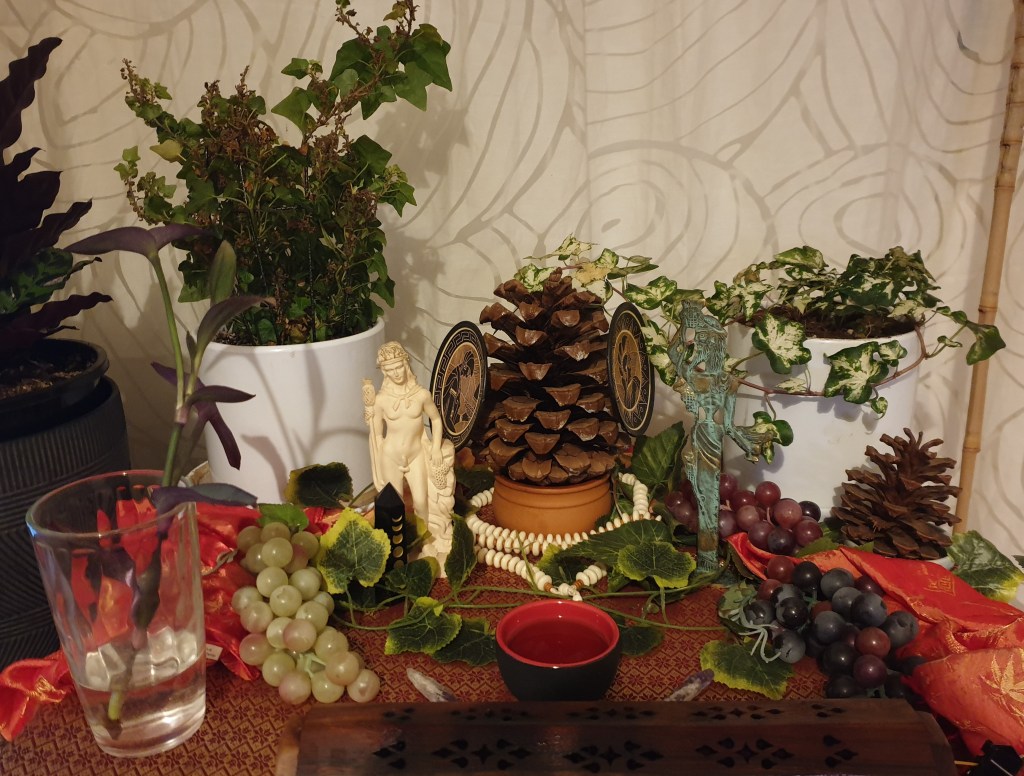
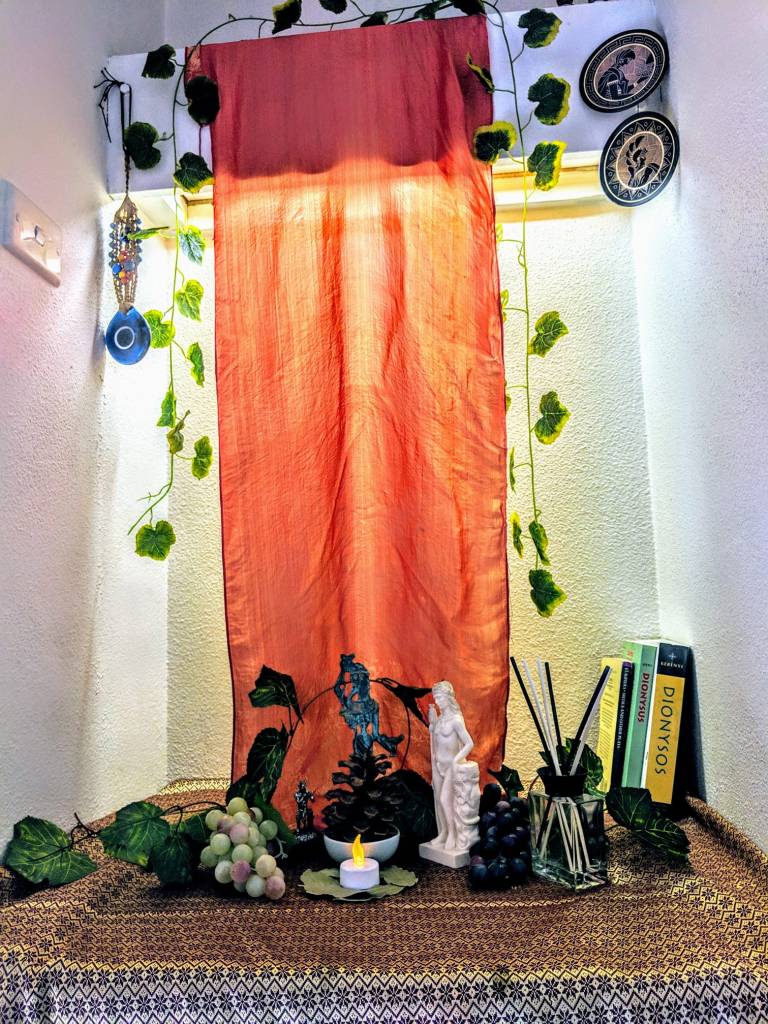
Below are examples of some of my shrines/altars past and present.
A Note: This is a developing list and will be edited to include more books in the future. (Last edit: 31/07/25)
Modern Books – Academic and Pagan:
– Ancient Greek Cults: A Guide by Jennifer Larson: (Larson is a modern academic who details a lot of new information regarding Greek religion, she has several books on this topic, all recommended.)
– Ancient Greek Religion by Jon D. Mikalson: (This book is designed to be an easy-to-approach discussion on Greek religion.)
– Greek Religion by Walter Burkert: (Burkert is a classic author who introduced Hellenic Polytheism to larger audiences. However, some of his writing is dated compared to recent studies. He has other books on Mystery cults and Orphism.)
– Hellenic Polytheism: Household Worship by Christos Pandion Panopoulos and Vasilios Cheiron Tsantilas: (Aka Household Worship is a book by the religious reconstructionist organization in Greece, Labrys. A second volume will be released soon.)
– Kharis: Hellenic Polytheism Explored by Sarah Kate Istra Winter: (Kharis is by a polytheist/animist, it includes both modern and ancient polytheist ideas.)
– Myths, Muses and Mortals: The Way of Life in Ancient Greece by William Furley: (this book has just recently been published, it covers much of Greek life, from fashion to Mystery religion. Most topics are brief, but is a good reference and easy read.)
– Old Stones, New Temples by Drew Campbell: (This book is currently out of print and can be difficult to find physically. However, it is available digitally through the Hellenion organisation.)
– Routledge: Taylor & Francis Group – a publishing house, has a series of academic books called “Gods and Heroes of the Ancient World”, each book is dedicated to a particular god or hero.
– The Waters of Mnemosyne: Ancient Greek Religion for Modern Pagans by Gwendolyn Reece (I have yet to read this but it is highly recommended by my pagan peers. Reece is a pagan/polytheist writer.)
– Notable authors/academics: Fritz Graf, Karl Kerényi, Radcliffe G. Edmonds, Robert Parker (Parker’s books are notable for festivals, and miasma), Sarah Iles Johnston.
Ancient Books:
– Homeric Hymns attributed to Homer, but by multiple anonymous poets: (I recommend direct modern translations.)
– Greek Magical Papyri (AKA PGM: A Greco-Egyptian spell book, a translated volume 1 is currently available by Hans Dieter Betz.)
– Iliad / Odyssey by Homer
– The Orphic Hymns attributed to Orpheus, but by an anonymous poet/s, (recommended translations: Apostolos N. Athanassakis, Patrick Dunn, Sara L. Mastros. More info below.)
– The Works and Days / Theogony by Hesiod
– There are lots of authors from antiquity that give insights into the Greek way of life, and poets with hymns, this can include Aristides, Callimachus, Herodotus, Pausanias, Pindar, Plato, Sappho etc. theoi .com often has citations and references from various authors.
Dionysian Pagan Authors:
– Eleuthereus: Towards a Theology of Dionysian Liberation by Fabian MacKenzie (a unique book that explores the philosophical ideals of Dionysian Liberation Theology.)
– Dionysos: Exciter to Frenzy by Vikki Bramshaw: (Covering basic Dionysian concepts, Bramshaw approaches Dionysus from a Wicca POV, but the author relies heavily on Kerenyi and Otto.)
– The God of ecstasy: Sex-roles and the madness of Dionysos by Arthur Evans: (Evans is a queer pagan activist. This book explores gender and queer roles by examining The Bacchae. How the play subverts the conventions of the patriarchy both in antiquity and modernity.)
– God Who Comes, Dionysian Mysteries Reclaimed: Ancient Rituals, Cultural Conflicts, and Their Impact on Modern Religious Practices by Rosemarie Taylor-Perry: (I have not read this book, but it examines Dionysian Mysteries and plants. I am also unsure if Taylor-Perry is pagan…will edit if I am incorrect.)
– Written In Wine: A Devotional Anthology For Dionysos – published by Bibliotheca Alexandrina: (As an anthology, it has multiple contributors, essays and poems.)
Dionysian Academic books:
– Dionysos by Richard Seaford: (Seaford is a modern academic, who overviews all prior writing and includes his own theories.)
– Dionysos: Archetypal Image of Indestructible Life by Carl Kerényi: (Kerenyi is a Jungian academic, though he provides a lot of insight into the history and development of the cults of Dionysus. Just keep in mind that some of Book 1, which details the Minoan way of life can be out of date.)
– Dionysus: Myth and cult by Walter Otto: (one of the early, most influential, academic books on Dionysus.)
– There are also lots of specific books on topics regarding Dionysus like, “Dionysus and Politics” edited by Filip Doroszewski and Dariusz Karlowicz. “Gods of Love and Ecstasy: The Traditions of Shiva and Dionysus” by Alain Daniélou. “The Dionysian Gospel” by Dennis R. Macdonald.
Dionysian Hymns:
– Homeric Hymns Hymn 7 is to Dionysus, (I prefer direct translations Penguin classics is usually okay).
– Liber Dionysi by Fabian MacKenzie, includes old and modern translations and hymns (see notes above.)
– The Orphic Hymns good translations include Apostolos N. Athanassakis (a direct translator), Patrick Dunn (an academic polytheist), Sara Mastros (a witch/scholar).
Essential Dionysian Myths:
– Dionysiaca by Nonnus: (is the last classical epic and is extremely long. There are two main translations: the Rouse version, which is old and open access, and “the Tales of Dionysus” version, which is not a direct translation but modern.)
– The Bacchae by Euripides: (I prefer direct modern translations. This play is often regarded as essential reading for Dionysians. Richard Seaford has a translation with commentary and analysis on the play.)
This post is inspired by Michael Webster’s Ways of Interpreting Myth course/lecture.
Introduction:
Mythology is a beautiful and important aspect of Hellenic Polytheism as it offers us a glimpse into how bronze age people looked at the world around them and their relationship with the divine. Out of the kaleidoscope of mythical stories, we see the correspondence between man, nature and the divine. Making myth essential to understand. However, we are sometimes faced with dilemmas such as: “Is myth truth?” “Does this horrible myth about a god change my opinion of that god?” “Are these gods rivals because of this myth?” – so on.
The idea of this post is to provide insights into understanding and interpreting mythology and why it’s important not to take mythology at face value. Myths should not be read as literal, but at times they may contain certain “truths”, so how do we interpret myths?
*****
According to Michael Webster, there are 12 methods for interpreting myths, this post will discuss each in a summary. In some situations, one myth may be interpreted by multiple methods.
1. As a belief system
Belief system mythology are typically myths believed as a religious “truth”, but as a polytheistic culture, there were few uniform beliefs shared between the people collectively. However, certain myths enforced a general concept of the hierarchy of the divine; for example, cosmology myths usually agree about the establishment of the Olympian gods as chief gods, with Zeus as king. This forms a unified belief system. However, some myths are strictly local myths, therefore, they help establish local customs and cultic beliefs. For example, Theseus and the minotaur is an Athenian hero myth and helped establish the national identity of Athenians, but the same minotaur myth retold elsewhere in Greece may have replaced Theseus with another hero (Herakles).
2. Disguised history
Some myths may hide a trace of historical truth. This was noted in antiquity by philosophers, such as Euthemerus (300BCE), who speculated that the gods were originally historical living people and through ancestor worship, time and fame they were elevated to godhood (this is a debated theory, esp., in regards our modern knowledge of Proto-Indo-European religions ((PIE)). Other myths include the real conflict of Troy. Theseus and the Minotaur, which may be a myth explaining Athens’ escape from Minoan vassalage. The affairs of Zeus myths might explain the tribal “Divine Right” claims of kings and leaders or the development of different sects and beliefs. Battles between gods, giants and titans may also represent natural cataclysms.
3. Disguised philosophy or allegory
Ancient philosophers were often ashamed of the behaviour of gods in mythology and sought to rationalise myths by applying philosophical explanations, therefore, myths can be read as allegory. Examples are: Zeus consuming Metis (wisdom), this explains Zeus’ supremacy and wisdom. The Orphic story of Zagreus-Dionysus being slain and cannibalised explains the refinement of the grape to wine and the development of the human soul and the World Soul (Neoplatonist). The Gigantomachy may explain the gods’ conquests over the material and, thus, a division between material earth and immaterial heaven.
4. Fables as moral truths
Some myths detail social morals and basic ethics. Examples are the myth of Philemon and Baucis, which is a myth about Xenia (hospitality). The story of Lycaon attempting to fool Zeus into eating human flesh is about the immoral acts of murder and cannibalism. Apollo and Artemis slaying the Niobids is about hubris. Midas and the golden touch is about wealth vs nature and greed. These myths explain why something is bad and act as a warning for breaking these moral codes.
5. Allegories of natural events
Hellenic Polytheism is inherently related to nature, so of course, many myths reflect this. An obvious example is Persephone retreating to the underworld a few months in a year, which causes seasonal change. However, other myths can be interpreted in this manner, like Herakles and Hydra, which may be a myth about damming a river and irrigation. Herakles’ labours may also be an early agricultural calendar, with each of the twelve labours symbolic of months of labour a farmer must fulfil to grow crops.
6. Pre-scientific explanations
Greek philosophers were always questioning everything, but often, there was no easy answer to these inquiries. Some myths explain things that were not understood. An example is Nyx and her cloak of night, which explains the stars. It was believed that there was a universal light called Aether, and when Nyx shrouded the world in her cloak, this light would beam through tiny holes in her cloak, making the stars. Chariot riders drawing the sun and moon is a mythic symbol common in PIE religions and are present in Greek myths with either Helios/Apollo or Semele/Artemis taking on the roles as drivers. These symbols, of course, explain the supposed movement of the sun and moon across the sky.
7. Customs, institutions, or beliefs
Similar to “2. Disguised as History”, these myths explain the function and formation of beliefs, customs and institutions. An example is Demeter’s establishment of the Eleusinian Mysteries. How Aristaeus learnt bee keeping and the development of the new year. Various myths regarding the founding of cities, like the competition between Athena and Poseidon and the naming of the city of Athens, or the myth regarding Cadmos and the establishment of the city of Thebes.
8. Religious power, metaphors of the unknown
These myths explain cult centres and establishments of authorities and divine order, such as Delphi being the centre of the world and home to the famous oracle. Landmarks like Mount Olympus as home of the gods. These myths can include divine order and customs surrounding culture and practice in worship like the Homeric hymn to Hermes and sacrifice.
9. Expressions of religious rituals
Myths that explain ritual practice and regulations. These myths can include those that detail initiation into Mysteries, the rituals and symbols associated with these rites. Other myths may explain why certain festivals were held on a certain date, like a god’s birthday, or festivals like the Dionysian festival of Anthesteria. These myths can include ideas of purity and miasma, why and how a person needs to be cleansed if they have committed a grievous crime like murder.
10. Psychological archetypes
This is a more modern, analytical take on mythology, popularised by Carl Jung, who viewed myths as representing humanistic archetypes. This take on studying myths looks at similar patterns or themes in our human psychology. An example is how there often are gods of love in comparative mythology and why these gods, such as, Eros (Greek) and Kama (Hindu) shoot arrows of love, which highlights the human and primal attraction we face when falling in love — as if struck or shot with love. Other archetypes are tricksters, shadows, fathers, mothers, children etc. Looking at myth in this method can add a new layer to understanding.
11. Stories
Some myths are just stories, though an interesting aspect of comparative mythology is that these folk stories often share similarities, even in cultures that never encountered each other. Related to Jungian archetypes, it’s a method of comparing similar ideas; for example, myths regarding the sun and moon share similar themes in world cultures because it is a universal experience wherever we are. Flood stories are another example of this; nearly every culture has a “Noah’s ark” kind of story, obviously because flooding is a catastrophe that can occur anywhere.
12. Social systems or conflicts
This is an advanced comparative myth interpretation method known as the “structuralist method”, proposed by anthropologist Claude Lévi-Strauss. Some myths embody in their structure contradictions and justify these contradictions. Themes include (quoting Webster): “noticing pairs of opposites like raw vs. cooked (Prometheus and some Norse tales), high vs. low (sky gods vs. earth gods), male vs. female, men vs. gods, profane vs. sacred, wild vs. tame, waste vs. cultivated land, and (most importantly) nature vs. culture.” A prime example is the myth of Zeus being fooled into accepting offerings of fat and bones instead of the edible parts of meat. Also related is the myth of Prometheus giving fire to mankind and the curse Zeus and other gods place on humanity (Pandora). These contradictions appear regularly in mythology as patterns and thus can be understood through these patterns as a whole. Webster recommends Edmund Leach’s book on Lévi-Strauss for additional information.
*****
Final words
With these 12 methods, it is possible to analyse myths or, at the very least, open the myths up for deeper insights. As I mentioned in the introduction, myths should not be taken at face value. There may be a particularly horrible myth about your favourite god that deals with sexual abuse, but this myth likely has a deeper meaning than just abuse. It may explain the transition of seasons or the divine right of the local royal family. It could explain the transition of a god to another or the cultic beliefs of the people. It’s not exactly about the ‘sexual’ act in the myth, but what the myth means underneath the storytelling.
Hello and welcome to the new blog by Markos Gage – The Thyrsus.
I am a long-time writer and artist involved in the polytheist and pagan community. Previously known as The Dionysian Artist, I feel that I have outgrown that old blog and wish to restart anew.
The intention of this blog is to share my insights and offer suggestions in the exploration of the Dionysian religion and general Hellenic and Mediterranean polytheism. Here, you’ll find my free to access writing, commentary and discussions on subjects I feel are relevant towards our community.









 The Thyrsus