
Content Warning: It should be obvious that this article discusses adult themes, including topics of sex, violence, and SA.
Foreword & Notes: The intention of this article was originally written for the Dionysian Wiki; however, as it ballooned out to almost 3,000 words, I thought it would be better to rewrite a more concise version for the Wiki in the future and publish this article here. In the mythology section, I purposefully left out a discussion on Attis and Agdistis, as those deities are meant to be covered in their own articles. That said, they do have relevance to the topic and Dionysus, so I would highly recommend researching their myths if you’re interested. In addition, I would recommend my article on the Pine Tree for more information regarding trees, the phallus, and castration. My spelling/style is designed for the Wiki, which is US-based and uses the Latin spelling of Dionysus and other gods.
The phallus is a symbolic or literal representation of a penis. It is a symbol found in many world religions. For Dionysians and Hellenic Polytheists, it has a multitude of meanings, including: death, destruction, family, fertility, life, magic, manhood, Mystery, power, and protection.
History
Icons of ithyphallic deities exist throughout prehistory. The most ancient phallus in Europe, dating to 28,000 years, was discovered in Germany (1) and some of the earliest depictions of an assumed ithyphallic wine god, found in Georgia, date to the 6th Millennium BCE. (2) Greek and European symbolism is possibly Indo-European in origin, as its meaning is shared throughout the world from ancient (and modern) Celtic, East Asian, Egyptian, Indian, and Germanic cultures.
A commonality of ithyphallic gods is the loss or castration of their penis and restoration/reparations, examples are Attis, Dionysus, Osiris, Phanes, Priapus, Shiva, Ouranos, and Zeus. This loss and restoration are sometimes associated with the transition of power from one god to another (Phanes and Ouranos), or an evolution of the god, a greater understanding, wisdom, and maturity (Dionysus, Osiris, and Shiva).
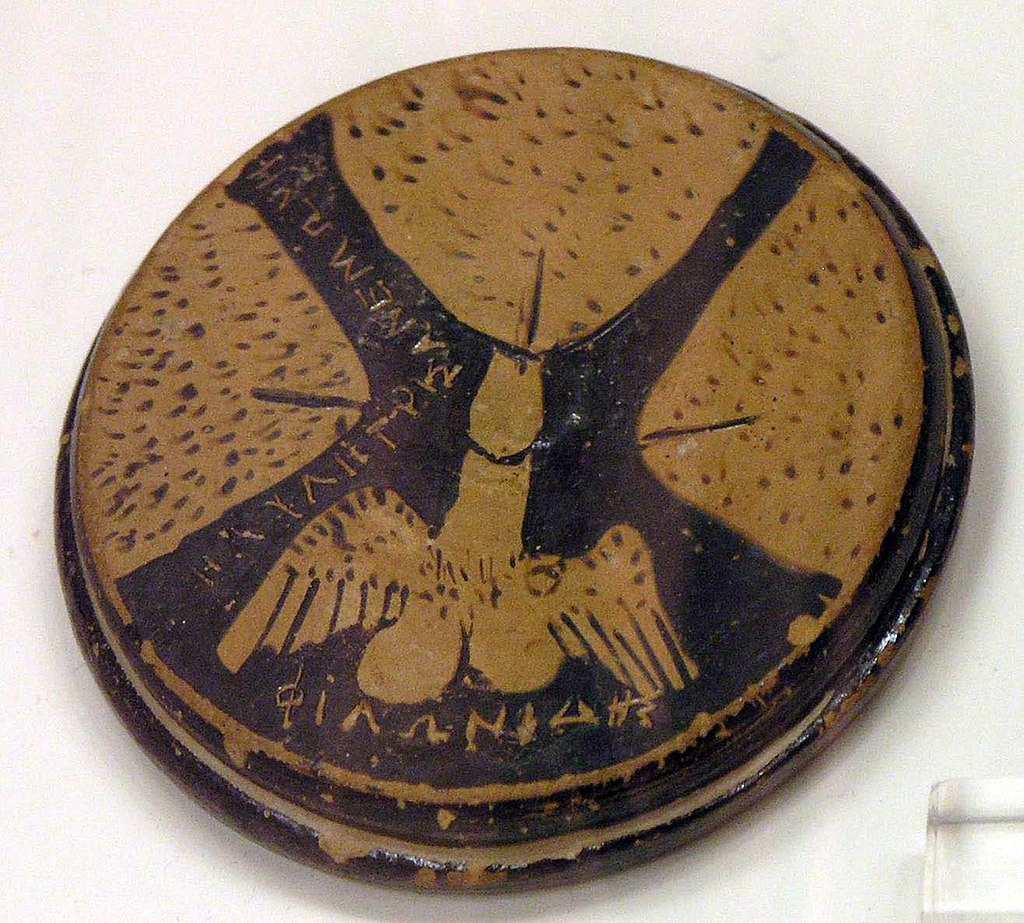
In Hellenic and Roman cultures, the phallus was often utilized as an apotropaic symbol, sometimes displayed on shields or worn as a charm to protect children. (3) It also featured on buildings and Herms to help protect and safeguard homes and businesses.
Symbolism
“Freud thinks primitive man preened himself on his ability to put out a fire with a stream of urine. A strange thing to be proud of but certainly beyond the scope of woman, who would scorch her hams in the process. Male urination really is a kind of accomplishment, an arc of transcendance. A woman merely waters the ground she stands on.”
Sexual Personae, Camille Paglia (4)
As observed by Freud and Paglia, the symbolism of the phallus is that of a magical object. Men are able to perform “miracles” by standing while urinating, and the act of putting out fire with their penis, or watering the ground, links back to the process of rain and storms. Likewise, the fertility of the soil and the fertility of the womb, the sky god and the earth goddess. The phallus is thus a magic wand, an object of power that transforms shape from states of flaccid to erect and is capable of creating life.
In addition to the above Paglia quote, she notes that animals mark their territory with urine, and primitive man did something similar. The phallus in antiquity was often used as a boundary marker, sometimes a literal signpost in the form of ithyphallic Herms. These were at first stone cairns, maybe even gravestones, but evolved into a pillar with a phallus on it. (5) The phallus and gods like Hermes and Dionysus are liminal psychopomps that can transcend boundaries from life to death. The liminality of the phallus is evident in the act of sex, with the penis entering and exiting an orifice.
The patriarchal societies of Ancient Greece regarded semen to be the generative component of pregnancy. The word “sperm” comes from the Greek literally meaning ‘seed’ Sperma (σπέρμα). Aristotle had a misogynistic belief that semen contained masculinity and was thought to hold the wisdom and knowledge of men. This knowledge was only transferred from father to son. The daughter inherited the attributes of their mothers. (6)
In apotropaic magic, the penis can also be used as a weapon, with the act of sex, penetration, potentially considered violent. Thus, it was a ward against the “evil eye”, the counterpart to the phallus, like the gaze of the Gorgon/Medusa. In a mosaic from the “House of the Evil Eye” in Antioch, the phallus is depicted ejaculating on the evil eye. (See below image) (7) Romans also used the threat of rape by Priapus to warn off thieves in gardens:
“I warn you, my lad, you will be sodomised; you, my girl, I shall futter; for the thief who is bearded, a third punishment remains.” A Roman epigram dedicated to Priapus, a threat to would-be thieves. (8) (9)
Plutarch was aware of the comparisons between the Osiris and Dionysus dismemberment myths (see below), and related the phallus to the Nile, or any river, moisture, and fruit trees, symbolic of wetness, procreation, and fertility. As rivers empty into the sea, they mimic the myth of dismemberment as the river loses its identity. (10) Walter Otto additionally links the moisture of the phallus with the fig tree due to its milky-like sap resembling semen and associated myth as the first dildo (see below). (11)
The Greek dream interpreter, Artemidorus, had several meanings for the phallus, connecting it with blood relations, children, family, material possessions, necessity, ownership, slavery, and wives. (12)

Public Domain
Dionysian Connections
Dionysus is an unusual ithyphallic god, in that he is rarely depicted as sexualized, or with an erect or enlarged penis. Instead, in art, his followers are the ones engaged in these acts, like phallic satyrs, centaurs, and animals like cockerels, bulls, donkeys, and goats. In orgiastic scenes, Dionysus appears almost asexual, disengaged, or apart from the scene before him. (13) Carl Kenyeri notes that in comedic satyr plays, all the actors, except the one playing Dionysus, wear leather phalli as part of their costume:
“[…] so that it became an accessory of comic actors and was also set up as a choragic monument. The god never wears it, but his companions, the sileni and satyrs, are ithyphallic.” (14)
This is because Dionysus is the literal representation of the phallus in human form, similar to how he is represented as a pole or tree – an alternative phallic symbol. (15)
According to Herodotus, Phallic processions were introduced to Greece by the Dionysian prophet and hero, Melampous. These processions included a large wooden phallus that was decorated with wings and pulled on a cart or had wheels attached to it. Jennifer Lawson states that this phallus was a literal representation of the god and served as a temporary simulacrum, as it was disposed of into the sea after the festival. (16) Walter Burkert also mentions this festival and believes the disposal of the phallus at the end of the festival is symbolic of the sacrificial castration of Dionysus. (17) This is further supported by Plutarch, as mentioned previously, who associated the phallus with rivers entering the sea, symbolic of castration.
The winged phallus and its associations with birds were a common symbol in antiquity, as exemplified in the phallic columns found in the Stoibadeion, a temple to Dionysus on the island of Delos. Carved into these columns are cockerels with elongated necks to represent a penis. (18) Winged phalli also feature regularly in Roman artwork. Euphemisms between birds and the penis persist today in European languages like the English word: “Cock”, the Italian “Uccello” (bird), the Czech “Ptak a vejce” (bird and eggs), Spanish “Polla” (cock), etc.
Mythology
In antiquity, the similarities between the Osiris and Dionysus dismemberment myths were noted. (19) The general Egyptian story is that Osiris was murdered by his brother Set, who cut up Osiris into numerous pieces and scattered them throughout Egypt. Osiris’s wife, Isis, mourns the loss of her husband and, with the aid of other gods, collects his body parts. Isis breathes life into Osiris once again, but this is only temporary. She copulates with him and conceives his future son Horus. It’s in Plutarch’s account that Set buries each part of Osiris’s body except his penis, which is disposed of in water and eaten by fish. Isis is forced to reconstruct his penis with magic.
Carl Kerenyi recounts a similar myth that he believed originated from the Hittites and was adopted by archaic Greeks. The myth features Zeus fighting the dragon Typhon on Mount Kasion. Zeus wrestled with the dragon, but Typhon took a sickle and severed Zeus’s tendons, (Kerenyi believes this to be a euphemism for the male member), removing his hands and feet and hiding the body parts in a bear skin sack (Korykion antron), this sack was protected by the dragoness Delphyne (related to Delphi), but eventually stolen by Hermes and Aigipan (Goat Pan) who reconstructed Zeus to continue the battle against Typhon, defeating the dragon. This myth is likely a precursor to the later myth of Apollo slaying the Python and the establishment of Delphi as a cult center. (20)
The Orphic myth of Zagreus is fragmentarily recorded as early as the 5th century BCE (21) but elaborated on later in history. In the myth, Zeus has an affair with Persephone, and she births Dionysus Zagreus (the hunter, the first Dionysus). Zeus recognizes Zagreus as a supreme godchild and gives the infant the scepter and throne of the cosmos. Hera, irate and jealous of this affair and the transition of power, released the Titans upon Zagreus. However, the Titans were unable to approach the powerful god who continuously changed forms from various creatures and monsters. The Titans conceived a plan to fool the child, disguising themselves with chalk face paint and tempting the child with various toys. Zagreus was disinterested in the toys except for the mirror, entranced in his own reflection, Zagreus dropped his guard, and the Titans pounced on the child, tearing him into pieces. They boiled and roasted his body parts, except his penis and heart, and ate him. Zeus smelled the foul odor of the ‘meal’ and returned to find the atrocity. In fury, he blasted the Titans with a thunderbolt, disintegrating them. From their ashes arose humanity, humans, thus composed of Titanic and Dionysian elements. Either Zeus or Athena saved the heart of Zagreus, which was used to impregnate Semele, the future mother of Dionysus. The penis of Zagreus was saved by the Cabeiri (in some versions, the protectors of Zagreus), they took his penis to Samothrace and established a Mystery cult around it (see below). (22)
Phanes, again considered an Orphic god, sometimes regarded as a progenitor to Dionysus, is also recorded as being cannibalized, but in this case, it is Zeus himself who eats Phanes to consume his power for the cosmos. This myth is chronologically before the Zagreus myth, but specific details of the myth regarding the phallus have only recently come to attention with the translation of the Derveni papyrus (originally written in the 5th century BCE, additional notes added in the 4th century BCE). In the fragmentary papyrus, Zeus consumes the “pillar/rod” (phallus) of the cosmic sky god (addressed as Ouranos but sometimes considered Phanes). During this act, the cosmic sky god ejaculates into Zeus, which transfers the power to Zeus, allowing him to order the universe to his will. This narrative serves to illustrate that the phallus and semen are symbols of power. (23)
The following myth is recorded in its entirety by Clement of Alexandria, a 2nd-century CE Christian apologist and critic of paganism. (24) However, it is mentioned by Pausanias (25) and Pseudo-Hyginus. (26) In the myth, Dionysus desires to petition Hades for the soul of his mother and seeks the entrance to the underworld at Lake Lerna (in Argos). Lost, he requests the aid of a local shepherd Prosymnos (also known as Polymnos and Hyplipnus). Prosymnos agrees to help the god on the condition that they have sex. Dionysus vows to fulfil the shepherd’s request after his journey. In agreement, Prosymnos shows him the entrance. When Dionysus returns from his adventure, he discovers that Prosymnos has died. Dionysus instead seeks an alternative to his vow, he fashions a phallus from fig wood and finds the grave of Prosymnos, fulfilling his promise by ‘sitting’ on the phallus on top of Prosymnos’s grave. Clement of Alexandria attributes all Dionysiac phallic iconography to this myth, though that is likely incorrect. It is possibly related to a local Mystery cult in Argos. Carl Kerenyi notes the similarities of this myth with that of Osiris and Isis. Instead, Dionysus is taking on the procreative role in what is otherwise reserved for women. (27) Being a passive person in anal sex was considered effeminate in antiquity; thus, the myth can be translated as a form of castration, a loss of masculine power. (28)
Related Myths: Agdistis, Attis, Priapus, and Ouranos/Uranus.
Mystery Object
As mentioned above in symbolism, the phallus was utilized in public rites and openly displayed. However it was also a private Mystery object. In the Thiasus processions, a phallus was carried in a basket (liknon, cista mystica). This phallus was either a carved wooden icon or from an animal (a goat penis). (29) As we are unaware of the rites performed during the Mysteries, conjecture has to be used. The phallus was likely considered a literal icon of Dionysus and an object of procreation and rebirth. It was probably given as a sacrifice and buried or burned in his honor. Kerenyi and others have noted that a possible holy sexual act was performed or enacted, symbolic or literal, is unknown. The most famous example of Hieros Gamos (sacred marriage) was performed during the Anthesteria festival on the day of Choës. The symbolic queen of Athens (Basilinna) “married and consummated the marriage” to Dionysus at the end of the festival – how this rite was performed is largely unknown. (30)
Regarding Lake Lerna and the Prosymnos myth, Pausanias mentions that at the lake, “The nocturnal rites performed every year in honor of Dionysus I must not divulge to the world at large.” (31) This could mean anything, but given the scandalous writing of Clement of Alexandria, these nocturnal rites likely involved the phallus.
The Samothrace Mysteries are one of antiquity’s least understood established Mystery cults. It focused on the “Great Gods” and the Cabeiri, ithyphallic satyr-like dwarves, typically the sons of Hephaestus. As mentioned in the Zagreus myth the Cabeiri saved his penis and took it to Samothrace. Herodotus was apparently initiated into these Mysteries and claims that they were established by the Pelasgians (native Greeks), it is from the Samothrace Mysteries that the ithyphallic Herms were introduced to Athens, in regards to the phallus and the Mysteries, Herodotus says, “The Pelasgians told a certain sacred tale about this, which is set forth in the Samothracian mysteries.” (32)
Finally, I’ll leave this article with a quote from Plutarch, which describes the simplicity of Dionysiac celebrations as:
“A wine jar, vine, a goat, a basket of figs, and then the phallus” (33)
Sources:
1. http://news.bbc.co.uk/1/hi/sci/tech/4713323.stm Accessed: 2025
2. https://www.bbc.com/news/world-europe-41977709 Accessed: 2025
3. D Paleothodoros, Satyrs as Shield Devices in Vase Painting, 2001
4. Camille Paglia, Sexual Personae: Art and Decadence from Nefertiti to Emily Dickinson, page 24, 1990
5. Walter Burkert, Greek Religion, 1977
6. Maryanne Horowitz, “Aristotle and Woman,” Journal of the History of Biology, 9, 2 , pp. 183-213, 1976
7. https://europe.factsanddetails.com/article/entry-1167.html Accessed: 2025
8. Priapeia (trans.Leonard C. Smithers, Richard Francis Burton,1995) Note: a collection of epigrams dedicated to Priapus
9. https://www.maicar.com/GML/Priapus.html Accessed: 2025
10. Plutarch, Isis and Osiris, (trans. Frank Cole Babbitt, 1936), pages 81 – 83, 2nd Cent. CE
11. Walter Otto, Dionysus: myth and cult, page 158, 1933
12. Artemidorus, Oneirocritica, [On the Interpretation of Dreams] 1.45 (Trans. Robert J. White, 1975) 2nd century CE https://www.attalus.org/translate/artemidorus.html Accessed: 2025
13. Michael Jameson, Cults and Rites in Ancient Greece: essays on religion and society: The Asexuality of Dionysus, 2003
14. Carl Kerenyi, Dionysos: Archetypical Image of Indestructible Life, Page 285, 1976
15. Walter Otto, Dionysus: myth and cult, page 157, 1933
16. Jennifer Larson, Ancient Greek Cults: a guide, page 129, 2007
17. Walter Burkert, Homo Necans: The Anthropology of Ancient Greek Sacrificial Ritual and Myth, page 71, 1972
18. Jennifer Larson, Ancient Greek Cults: a guide, page 129, 2007
19. Plutarch, Isis and Osiris, (trans. Frank Cole Babbitt, 1936), page 87, 2nd Cent. CE
20. Carl Kerenyi, Dionysos: Archetypical Image of Indestructible Life, Pages 46-47, 1976
21. Aeschylus, Fragment 124 Sisyphus (from Etymologicum Gudianum 227. 40) (trans. Weir Smyth) 5th Cent. CE
22. Clement, Exhortation to the Greeks 2. 15 (trans. Butterworth) 2nd Cent. CE
23. Dwayne A. Meisner, Orphic Traditions and the Birth of the Gods, chap 2, 2018
24. Clement of Alexandria, Exhortation to the Greeks 2. 30 (trans. Butterworth) 2nd Cent. CE
25. Pseudo-Hyginus, Astronomica 2. 5 (trans. Grant) 2nd Cent. CE.
26. Pausanias, Description of Greece 2. 37. 6 (trans. Jones) 2nd Cent. CE
27. Carl Kerenyi, Dionysos: Archetypical Image of Indestructible Life, Pages 310 – 311, 1976
28. Walter Otto, Dionysus: myth and cult, page 176, 1933
29. Carl Kerenyi, Dionysos: Archetypical Image of Indestructible Life, Page 354, 1976
30. Carl Kerenyi, Dionysos: Archetypical Image of Indestructible Life, Page 171, 1976
31. Pausanias, Description of Greece 2. 37. 6 (trans. Jones) 2nd Cent. CE
32. Herodotus, The Histories, book 2, capt 51 (trans. A. D. Godley, 1920), 430–440 BCE
33. Walter Otto, Dionysus: myth and cult, page 164, 1933 (Note: quoting Plutarch)
 The Thyrsus