My Notes on Otto & Kerenyi

This is for personal study and isn’t designed for academic use. I thought I’d share this here as a resource, as it includes interesting quotes and references to certain subjects. These notes are by far from comprehensive, but I still use them as a go-to reference.

(Edit: apologies for initially misspelling Kerenyi’s name. I get n’s and r’s confused, it’s a dyslexic thing.)


Dionysus: Myth and cult by Walter Otto (1933), Translated by Robert B. Palmer (1960) ISBN 978-0-253-20891-0
“The Pharmakos was led around the entire city to absorb every Miasma. He was then killed and burned or taken over the boarder of the country, just as one wipes a dirty table off with a sponge and then throws the sponge away.” P39 (Nilson, 112.F)

“Grim customs like these offset by more cheerful ones […] It was the custom in Tanagra for the handsomest young man to walk around the city in the Hermes festival with a ram draped over his shoulders. The god himself, as the story goes, once freed the city from a pestilence by making the rounds in this way, and the ritual was established to commemorate this event.” P43 (Pausanias 9.22.1.)

Note: Semele is the Phrygian name of the Earth Goddess and that Bakchos is the Lydian equivalent for Dionysos. P60 (This statement is questioned by Otto) Note: “Bakchai” a group of followers of Dionysos, “Nysai” a group of Nurses. P61

“According to the legend of Brasiai on the Laconian east coast, the child Dionysos was supposedly washed up on the shore in a chest together with Semele, and, since his mother was no longer alive, he was raised in a grotto by Ino.” P63, Pausanias 3.24.3.

“The one in the cradle” P82, Hesychius.

“[Whereas the gods] are invisible when they enter their temples on their feast days, Dionysos arrives in the flesh; ie., in a plastic image.” P83

“There can be no doubt, however, that Dionysus was thought and felt to be present with overwhelming certainty. He whom the women attend, he who always has a favourite at his side, stepped over the threshold of his earthly home and took possession of the mistress.” PP83-84

““Tree Dionysos”, Plutarch says, he was worshipped almost everywhere in Greece.” P87

Note: Masks of Dionysos Bakcheus and Meilichios were made from wood of grape and fig tree. P88

“Thus even the Gorgon is first supposed to have received her well-known masklike image because people once were in the habit of wearing her mask in apotropaic rituals.” P89

Note: Artemis Orthia is associated with Dionysos through her epithets. P104

“According to Nonnus Aura, too, the beloved of Dionysus, killed one of her new-born children and devoured it.”

Note from Nonnus: “The Indian Deriades complains of the impossibility of conquering Dionysos because the many-formed one was now a lion, a bull, a boar, a bear, a panther, a snake, and now a tree, fire, water” P110

“There is also a tradition that it was Dionysos who sent the sphinx to the Thebans.” P114

“The Agrionia (or Agriania, Agranoa) day of the dead P118 (Note: May have been linked to Anthesteria, the Agrionia took place one month after Elaphebolion.)

“In the new-born child the ancestor rises up out of darkness of death. This is the reason why the divinities of birth and fertility are so close to the divinities of death.” P138

“The madness which is called Dionysos is no sickness, no debility in life, but a companion of life at it’s healthiest.” “[…] it is the madness inherent in the womb of the mother.” P143

“Herodotus (says) there was an oracle of Dionysos in Thrace with a prophetess, as in Delphi.” P144

“This is why the Thebans considered an ivy-twined column sacred to the god and, in fact, called Dionysos, himself, the “One who is entwined around pillars”. “The spring at Thebes in which the nymphs supposedly bathed Dionysos after his birth was called Kissusa after ivy.” (Note Kissusa is another epithet for Dionysos.) P153

Note: according to Diodorus, the care of fruit, in general, is ascribed to him (Dionysos). P157

Pinetree ref P157

“Pindar: alludes to roses and violets with special affection, when it is said quite specifically, in fact, that “Bacchus loves flowers”, there, is nothing more in all this than that he happens to make his marvellous appearance in the beginning of spring, and the lovely progeny of earths floor announce his coming and adorn his path.” P159

“The charities from Orchomenus […] are called Dionysus and Aphrodite’s daughters. P164

“A wine jar, vine, a goat, a basket of figs, and then the phallus” – this is the description Plutarch gives us of the original simplicity of the Dionysiac celebration. P164

“Dionysos Melanaigis was Dionysus Morychos, “the dark one”.” P169

Note: Names of woman followers: Laphystiai, the Dionysiades, the Leucippides, the Bassarai, the Dysmainai, the Klodones, the Mimallones, the Lenai, the Genrarai. P175

“Aeschylus calls Dionysos “The womanly one” and Euripides “The womanly stranger”, and “man-womanish”.” P175

Note: Ariadne was closely related to Aphrodite. In Amathus Cyprus she was worshipped as “Ariadne Aphrodite.” P182

Note: Ariadne is said to have been buried in the Dionysian sanctuary. P182

Note: Ariadne had a sea crown, sometimes made of coral. Note: Ariadne has many links to the sea, including being a possible nymph that nursed Dionysos as a babe. P187

Note: the 8th of November was apparently the date of Dionysos “awakening” and on the island of Andros the None of January was his return with the sun. Chapter on Apollo discusses the possibility of Dionysos was in Delphi before Apollo’s cult. Starts P.202


Dionysos: Archetypical Image of Indestructible Life by Carl Kerenyi. Translated by Ralph Manheim 1976, reprint of the Mythos series 1996, ISBN: 0-691-02915-6
Part One

Notes on Chapter 1: The Spirit of Minoan Art: Zoe = indestructible life, Bios = dying life (rotting life, biodegradable), Physis = plant life. Kerenyi proposes Dionysos represents all aspects, though he is chiefly the archetype of Zoe. This is the core theme of the Kerenyi’s book.

Minoan Visions: Discusses Opium and the cultural influence on Minoan art.

Notes on Chapter 2: Light and Honey, Flaming New Year: Religious holidays set to the star Sirius, with the new year on the “dog day” summer solstice. This is observed in Olympia, Delphi, Athens and Epidaurus. “Hosian” a universal law that the even the gods cannot break. P30

Notes on Chapter 2: The Preparation of Mead: “According to Oprhic docrine, wine was among his last gifts.” P35 O. Kern, ed. Orphicorum fragmenta fr.116

“The original words “for to be drunk” and “to make drunk” are methyeim and methyskein. Rare and later is “Oinoun” (from oinos, wine) meaning “to intoxicate with wine.’ Echoes of Methy signify “honey’ not only in a number of Indo-European, but also a common Indo-European-Finno-Ugric stratum.” P36 (Cont. more details)

“Askos” An animal skin sack that was waterproof. P36

Notes on Chapter 2: The Awakening of Bees: Aristaios – domesticator of bees and mythical inventor of mead. P39

“Korykos” means leather sack P43

“Tainiai” narrow bands used to adorn sacred persons and objects. P44

“Liknon” a cradle and basket for sorting grain. Teos : Dionysian city in Aisa Minor. P45

“Pythia”, the Delphic oracle literally translated to “Delphic Bee”. P45

“Minoans gave a bull the name “Oinops” WO-NO-QO-SO (Linear B) meaning Wine coloured. P54 Note: Homer uses this name in regards to bulls.

In Greece the grapevine was called, “Hermeris” meaning “the tamed”. P57

In Attica Dionysos was called “Kissos” meaning Ivy. P63 (See notes from Otto)

“When grapes were pressed for wine people would sing a mournful song called “Lenos”. […] The second council of Constantinople, The Trullianum, 691 CE, formally banned the traditional song and crossdressing.
P67

DI-WO-NU-SO-JO : Linier B for Dionysos. P. 68

Note: Interestingly, the name “Pentheus” is early recorded and likely was an epithet of Dionysos. It literally means “great Suffering”. (Mega Pentheus”) PP. 69 – 70

Note: Melampous, the (mythic) soothsayer and priest introduced phallic worship to Greece. P72

“The wooden masks that were used in the Dionysian cult, either worn by or hung on a pole or tree in the centre of the rite. The Zoe that is present in all living creatures became a spiritual reality a man opened himself to it, perceiving it in a kind of second sight.” P80

“[Zagreus] makes it seem highly probable that on the kydonia seal we have a representation of Cretan Dionysos. The god holds fast the lions, two living beats of prey, with his bare hands. He tames them as it were, by a “laying on” of hands. He draws them into his sphere of influence and holds them captive.” P82

“In Greek, a hunter who catches live prey is called Zagreus.” P82

“The pantheon was roofed, roughly between 450 and 400 BCE.” P97

Note: Daidalos, the mythical creator of the labyrinth, is related to oil, which was stored in the palace. Hinting that the connection of the labyrinth was associated with oil delivery. P100

“Ariadne’s name may indicate that she was a dark goddess, the goddess of the mountain. Related to another similar character Koronis the “Dark-crow-virgin” and the goddess Peresphone.” P103

Note: in coins Ariadne is connected with the moon. P104

Note: The Minotaur’s name is “Arsterios” or “Asterion” meaning Star or Starry. P105

“Artemis Apanchomene”, is the hung Artemis. P106

Note: Kerenyi links Ariadne to Persephone, making her Dionysos’s mother. These mother aspects are also mentioned by Otto. (Persephone being mother to Zagreus.) PP110-111.

[…] “though marriage with this heavenly dragon Persephone’s womb became fruited, prepared to give birth to Zagreus, the horned infant.” P114 (Nonnus VI 120-697)

“The ‘mystic’ feature which we have presupposed in the relationship between Dionysos and Ariadne here appears in an archaic myth in which generations of birth never go beyond the same couple. Taking his mother or daughter to wife, the son or husband begets a mystic child who in turn will court only his mother. To such involvement the snake figure is more appropriate than any other. It is the most naked form of Zoe absolutely reduced to itself.” P114 (Note from Markos: Ouroboros and the myth of Phanes.)

“The snake, the genius as a whole, was indestructibly precent, bearing witness to the indestructibility of life in what was, in a manner of speaking, it’s lowest form.” P115

In Latin: “Taurus draconem genuitet taurum draco.: English: The bull is father to the snake and the snake to the bull.” PP117

Page 118 Discusses aspects of the Mystery cults.

““Dionysos Meilichos” his mask carved of fig wood. The name applied to the subterranean Zeus, who appears in votive reliefs as an anormous snake. Seducer in caves.” ““Bakcheus” the ecstatic god of life.” P123

Part Two: The Greek Myth

Note: Kerenyi discusses that he does not think the Dionysian cult was a spontaneous fad, nor a “missionary cult”, even though certain myths make it out to be. He note that other Hellenic cults have similar myths of a gods arrival and “take over”, such as Apollon. P140

Note: Discussion on the thanksgiving festival that marked Theseus’s return from Crete. This includes thanks to Dionysos for taking Ariadne in exchange for safe passage. PP145-146

Note: In Athens the festival Choës Day with the Aiora the “feast of the swings” signified the end of Erigone’s wanderings. It explains her myth of melancholy as the act of her hanging herself. Her death resulting in the marriage to Dionysos and her apotheoses to the heavens. Later the festival focused on her union in which saw ladies in waiting swinging on trees to advertise their availability for marriage.

“Swinging as a simple bodily activity, as a means of expressing intense joy of life.” “Swinging is also a natural magical action, for it artificially helps the swinger to attain an extraordinary state, hovering mid-air in a kind of ecstasy.”

“In this it so “more magical” than drinking wine. Between the two there is a kingship, but swinging involves still another element: an approach to the sky, to the sun and moon. The gloomy interpretation of the swinging […] [is to] atone for the death of Erigone by an epidemic of self-hanging […] the swinging was a substitute for this punishment.” PP156-158

Note: When Erigone ascends to heaven she becomes Virgo. P158

Note: Dionysos Melanaigis: “he with the black goat skin”. “They do not want the god in that form: they reviled him. Thereupon he makes them raving mad. In order to be cured, they obliged to worship Melanaigis, that is, the dark Dionysos in league with the spirits of the dead.” P163 (Suidae Lexicon) Note: Dionysos Melanaigis

“This cult was brought to Athens by Pegasos, a missionary. Offence caused impotence in men. Regarded as the seconded introduction to Athens.” “Axios Tauros” worthy bull. 173

Notes on: Myth of Arrival and Rite Outside of Attica: Thebes ad Delphi. A common theme in early myth is kings refusing to accept the “new” cult of Dionysos. Often the followers of Dionysos were beating, killed and in some instances Dionysos, himself, was beaten or slain. However, as a result of the king’s hubris, those that oppose Dionysos face his wraith:

A. King Lykourgos, the Thracian king that kills the nurses of Dionysos and beat the god to the sea (Homer) The king either goes insane or his own people kill him. B. The daughters of Minyas, they ignore and didn’t respect Dionysos when he arrived resulting in their madness. C. Perseus “killed” Dionysos when the god arrived at Argos, Perseus threw his body into lake Lerna. Dionysos was called back as Dionysos Bougenes (the cow’s son). Lake Lerna is one of the mythical entrances to hades and upon Dionysos’s return he reconciled with Perseus and “converted” him. Perseus established a temple to Dionysos and Ariadne in Argos as “Dionysos Kresios” the “Cretan Dionysos”. P180

The introduction to lake Lerna leads to Dionysos’s second decent to hades to retrieve the soul of his mother, Semele. Kerenyi claims that Dionysos sacrificed his masculinity here, as the price for his decent was the promise of sex with a man and “feminization” by the act. The result was a permeant phallic cult at the lake. Kerenyi continues that the Argos cult was an early precursor to the Theban cycle, with the original king in Argos being Megapentheus, son of Proitos, king of Argos. Like Pentheus of Thebes, Megapentheus name literally means “man of great suffering”, though the suffering of the king in the Argos cult was directed towards the king’s sisters. The sisters going mad doomed to wander the land in a state of nymphomania. P186

Discusses the unusual connection Dionysos has with Hera, as in archaic myths it is Hera that deals out madness. There is a mention that according to cult rules ivy was prohibited in Hera’s temples, with the exception of her mad cultic features. PP186-187

Dionysos Trieterikos God of the Two Year Period. “Dionysos Pelekys” Dionysos of the Double axe. 192

“Pentheus into the name of a punished enemy of the god, who nevertheless in his suffering remained so close to the god to represent him. The contradictory nature of the tragic fate of a god who suffers and lets himself be killed – a god whose servant, indeed he himself, was the sacrificial ox – was embodied in a man who destroyed himself, a frequent character in later Attic tragedy.” P193

The Maenadic state of mind is called “Mainomenos” – usually a negative Then “Thyiadic” and “Epiphoitian”, verb: “Thyein” P198

“Enthousiasmos” the state and act of being filled with god. P200

Details the two year festive cycle outside of Athens, the first year to the subterranean Dionysos, sombre and mellow period. The second year was more celebratory of life – though there were race instances of “human sacrifice”. Sources of this are dubious as they are mostly from Christian critics. PP202-203

“He who leads the throngs become Dionysos”. P203

This two-year festival was held in secret by woman from around Attika. Dated at roughly the 8th of November. They journeyed up the mountain to Delphi in dangerous conditions. What occurred during these rites is a mystery, though related to life, death, and rebirth. PP214-215

“Heroen Brephos” the Horned Infant. P249

“[…] when the vine has been heavily pruned after the win harvest, the earth restores it in order that it may bear fruit again in due season” “This is consonant with what is said in the Orphic poems and presented in the mysteries”. Diodorus Siculus III 6Z 7-8 P249

A Greek and Roman custom was observed throughout to an extent that it was a kind of law, called “Talion” for when goats were admitted to a vineyard they “sinned” against the vine. “ “So it came about,” says Marcus Terentius Varro, “that the he-goat were sacrificed to Dionysos, discoverer of the vine, as though to make atonement, a head for a head.”” “ “Very well, eat my fruit bearing vines: the roots will still bear enough wine to pour on you when you are scarified.”” Leonidas of Tarentum, an ancient proverb of the vine to the goat. P249

Mention of wine cults in the East:

  • Dolukbaba in Syria, holy mountain of Jupiter Dolichenus
  • Great Hittie god, grapes, related to Doliche
  • Dursares “The Arabian Bacchus”
  • Sumerians had a goddess called “Heavenly Vine”
  • Arabian Djinn “Umm Unkud: mother of grapes. P256

Basket that held Dionysos’ heart “Cista Mystica” (also see: “Liknon”

  • Note: continues connection between the heart and the phallus, “Kradiaios” P260

Orphism has been termed “Religious-Philosophical-Literary movement that cannot be defined with precision.” Kerenyi, W. Fauth. P262

The Dionysos of The Athenians and his worshipers in Greek Mysteries “Kradiaios Dionysos” Figwood Dionysos. The mask belongs only to him […], it is only seemingly empty. Behind it dwells a world of spirits, which sends its inhabitants out onto the Dionysian stage. Anthesteria.

  • Pithoigia. “Opening of Jars” It is somewhat unknown why the “Pithoi” jars were opened on this day, but Kerenyi says it was an ancient rite: “[…] in the Mycenaean texts of Pylos clay tablets. Here the souls of the dead are called dipsion, the “thirsty ones”. They were thirsty not for water but, in the year Dionysos dwelt emasculated among them, for wine.” “Attracted by the smell of the wine that rose from the opened pithoi and spread throughout the city, the souls emerged from the underworld. No one, not even slaves, was prevented from drinking wine on this day.” P303
  • Choës “From the wine pitchers” “When the world is open, it is as though the gates of sad subterranean gods were open.” “Choës day was marked by an erotic atmosphere and the presence of ghosts an unusual phenomenon but not humanly impossible.” P303-304

-Chytori “The day of pots” “was dedicated to Dionysos and Hermes […] wholly devoted to driving out and appeasing the spirits: the god who led them up from the underworld was supposed to lead them back down again.” “Out, you Keres, it is no longer Anthesteria!” “The pots, after which the day was named “Chytroi” contained food for the journey of the keres: cooked vegetables and seeds, a sacrifice to Hermes Cthonios and in Greece from time immemorial to the present, the food of the spirits of the dead.” “Their heads heavy with wine, the ghosts returned to the “swamps”, whiter the Athenians escorted them.” P304

In the Boukoleion only the “queen” and her handmaidens, the Gerarai, were permitted but only the queen could see and worship an archaic cult statue, an agalma. The event leading to this was a pompe, a marriage of sorts. During the parade a live male acted as Dionysos but during the Boukoleion ceremony the “consummation” was with the cult image.” 308-309

Symmeixis: “Physical union” but in a spiritual sense. Gamos : Bodily union a consummation matrimony/between god and woman. “According to Aristotle: the wife of the archon basileus entered into a higher marriage with Dionysos, made higher no doubt by the ineffable sacred ceremonies whereby she restored the god’s wholeness and created his full Parousia. It was her duty to do this each year.” P310

P310 – 311 Details that this act was performed by Dionysos himself in the myth of Prosymnos.

The sacrificial table was called “thymele” and also “éleos” the latter meaning pity. These platforms were of the first stages. P319

P320 Discusses the origin of the word “tragic” related to the irony of the goat dying to the object that sustained it.

P326 Mentions the first Dionysian Artist, linked with “Ikarian” performance and Thespis.

Thespis invented the stage and costume for performance, chalk faces to represent the dead characters in the plays. Canvas masks for the heroes. They wore wreaths of andrachne, knowns as “komaros” the strawberry tree, holy to Hermes. P327

“That you fart like a weasel” P338 (Markos note: I just found this hilarious)

By the classical period males could replace women in choruses but still wore women’s clothing, they were called “homoi”. P340

Comedies were chiefly performed by men only women were only props. Comedy was likely the first form of performance art, a drunken farce or open mockery of noble/public officials. However narrative comedy with a planned story was imported from Dorian Sicily after Athenian tragedy was firmly established. Ironically making the first and last artform of performance. P340

“Archiboukolos” Chief cowherder “Boukoloi” group of cows – cowherd – followers of Dionysos “Archimystes” chief initiate. “Boukoloi Hieroi” Holy Boukoloi “Heros” Priest, literal representative of Dionysos “Theos Dionysos” Literally god Dionysos, but may indicate the title to an actor playing as Dionysos, or it could indeed represent the god himself. 186BC is the date of the Roman Dionysian conspiracy – Livy, and ban of the Bacchanalia. “Monosandalos” to have only one shoe. P351

The ban against the Bacchanalia was lifted by Julius Caesar. P363

“To a divine encounter one is called seduced by a superior power. Where a living person is concerned; this person will achieve the Telos in a mystery ceremony through the gamos. Just this happens in the death of young people.” P369

Throughout Southern Italy the name “Ariadne” suggests itself for Dionysos’ divine partner, into whom the female deceased are transformed, while the males are transformed into Dionysos.” P369

“Both sexes achieve the same Dionysian apotheosis in death.” P370

“With such a conception of death the Dionysian religion of late antiquity diverted itself almost entirely of ethical philosophy of the Orphics. The terrors of death were overcome by the identification of the deceased man with Dionysos and by the belief that a deceased woman gave herself in love to the god.” P373

[Young Children] “If they died at this age went down to the underworld as little Dionyoi.” “They need no initiation other than a sip of wine -probably their first- from a small Chous. If they lived not much longer, was put into tomb with them as an identification.” (This explains the large number of children drinking vessels in museums.) P374

Diodorus Siculos wrote: He seems to be dual of form because there are two Dionysoi: the bearded Dionysos of the old times, since the ancients wore beards, and the younger, beautiful and exuberant Dionysos, a youth.” DS:IV52

Dionysos: The Civic God

Dionysos Eleuthereus by August Frickenhaus (Public Domain)

It is largely thanks to Friedrich Nietzsche that many people assume Dionysos is a god of chaos, discord, and social disorder. Nietzsche’s philosophy has had far-reaching influence, and for some, his writing was their first introduction to Dionysos. While Nietzsche’s work is profound and often beautiful, he employs the gods in service of his philosophical agenda. As a result, the modern image of Dionysos is frequently one of excess: wild drunkenness and orgies.

However, Dionysos is a god of paradox and duality. While he does embody liberation, ecstasy, and uninhibited passion, he is also a god of social order and civic structure.

This essay argues that Dionysos, often misunderstood as a god of chaos, was in fact a powerful force for civic cohesion, social innovation, and cultural development in the ancient world.

Wine: Fuel of the Bronze Age

Early myths involving Dionysos include an element that modern polytheists sometimes overlook: water. In Homer’s Iliad, Dionysos retreats into the sea to escape the wrath of Lycurgus. In Homeric Hymn 7, he is kidnapped by pirates, whom he later transforms into dolphins as punishment. In ritual festivals, he is often drawn in a ship, and his phallus is ritually thrown into the sea.  These stories and rituals hint at a maritime aspect of Dionysos — the first indication of his civic nature.

The sea was central to Aegean cultures; it functioned as the highways of the ancient world. Dionysos, in this context, becomes a symbol of maritime trade. Wine was not only a key trading commodity, it was essential to trade itself and, by extension, to the development of civilisation.

According to some of the earliest Mycenaean records, wine was among the most significant commodities of the Bronze Age. (1) What made wine unique was its regional character — influenced by soil, climate, and production methods. Each region produced wine with a distinctive flavour, and cities would exchange their local varieties with others. This trade helped form a wide network across the Mediterranean, fostering cultural relationships and opening channels for other vital goods, such as copper and tin — the foundations of bronze production.

Beyond trade, wine played a practical role in sea travel. Fresh water would stagnate and become unsafe during long voyages, while wine could be stored and consumed safely, helping sailors stay hydrated. Sea travel was long and risky; sailors often faced malnutrition. Scurvy, caused by a lack of vitamin C, was a common threat. Although Hippocrates likely did not understand the exact cause of the disease, he recommended wine as a treatment, and wine does contain vitamin C. (2)

Hippocrates also recognised the antiseptic and healing properties of wine. He advised that no wound be treated with any liquid other than wine. In regions like the island of Thasos, wine was produced specifically for medical use. This tradition continued into the Roman era, where the physician Galen recommended wine for treating wounds, digestive issues, and constipation. (3)

Wine was also vital to early urban life. Bronze Age communities lived in close quarters, often around a central fortress or polis, and dense populations would contaminate local water supplies. Clean water was often hard to access, but alcohol’s antiseptic properties meant that wine, even in small amounts, could kill harmful bacteria. This made life in the first cities possible.

Wine was central to Bronze Age life — fuelling trade, enabling safe seafaring, and fostering cultural exchange. It was, quite literally, the lifeblood of civilisation.

The Theatre: Birth of Democracy

Theatre likely originated in oral performances of Homer’s epics. A lead bard or chorus would narrate, while actors pantomimed scenes to illustrate the story. According to Aristotle, a major shift occurred when the actor Thespis began interacting with other performers using spoken dialogue, rather than simply miming alongside a narrator. (4) Actors took on distinct roles and brought characters to life — giving rise to tragedy. This innovation revolutionised theatre, providing a platform for actors and playwrights to express original ideas, often reflecting the political climate of the polis.

The origins of comedy are less clear. Aristotle claims the memory of comedy is lost, but theorised that it emerged from phallus dances or from popular protest. Lower-class citizens would cover their faces with chalk for anonymity and drunkenly shout insults or cause disturbances outside the homes of aristocrats. (5) These early farces eventually evolved into performance art. Over time, slapstick comedy gave way to more structured, narrative-driven satire. Comedy retained political relevance, frequently parodying prominent figures in the polis. Retaliating against comic artists was considered dishonourable, making satire a powerful — and protected — form of social critique. More than mere entertainment, comedy became an instrument of free speech and civic engagement.

The physical structure of the theatre itself is essential to understanding the rise of democracy. It served as a central gathering place for the polis, welcoming all social classes — even women and slaves. With attention focused on the central stage, the person who spoke there held a voice that reached the entire community. Politicians would often commission plays and precede them with public speeches, using the occasion to communicate directly with the people. In turn, the audience could respond, creating a forum for dialogue. The theatre, therefore, functioned not just as a space for performance, but as a civic centre — a place where political and social ideas were shared, tested, and debated.

Other important events took place in the theatre as well, including the freeing of slaves and the public announcement of citizenship. (6) The god presiding over this space was Dionysos Eleuthereus — Dionysos the Liberator — underscoring the theatre’s deep connection to freedom, expression, and civic life.

Artists as Leaders

Poets, playwrights, and actors held celebrated roles in Greek society. They were often welcomed by the ruling class and became politically influential, with some achieving legendary status. Artists were seen as intermediaries between the mortal and divine. By the third century BCE, the Dionysian Artists — a formal guild of performers — had become a recognised religious authority.

As an institution, the Dionysian Artists expanded their influence beyond art. They acted as diplomats and advisers, particularly in the post-Alexandrian world. Kings associated with the Dionysian Artists often adopted the title Neos Dionysos — the new Dionysos — to legitimise their rule through divine association. This practice continued into the Roman era, where emperors drew on Dionysian symbolism to reinforce their authority. (7)

The Boundless God

Worship of Dionysos could take place anywhere. He was not confined by borders, class, or politics. As a result, his processions travelled freely throughout Greece — even during times of war.

One notable incident, recorded by Plutarch, involved a group of Thyiades — Attic-Delphic Bacchants — who, overcome with Dionysian ecstasy, accidentally wandered into a rival city during a time of war. They fell asleep in the town’s agora, unaware of the danger. The next morning, local soldiers prepared to arrest them. In protest, the women of the city surrounded the Thyiades to protect them, then peacefully escorted them to the city’s borders. (8)

This example of free and unbounded worship was not unique. During the Dionysia in Athens, foreigners from other city-states were invited to participate, making the festival one of the earliest instances of religious tourism. From these urban celebrations, processions would spread out into the countryside, bringing blessings to villages and farmland, and sharing Dionysian revelry with all.

The Thiasus — retinue of Dionysos — often travelled to sacred sites, including groves and mountains, to perform rites and construct ritual objects such as thyrsoi and wreaths. These groups often included women, who held leadership roles and maintained the structure of the Thiasus. Participation in Dionysian rites granted them unprecedented women’s rights: the right to assemble, to travel independently, and to practise their religion without interference.

Similarly, the Dionysian Artists were granted exceptional privileges. They had the legal right to free movement and were exempt from taxation, arrest, or harm by any city-state.

Even slaves and prisoners were not excluded from Dionysian worship. During the Anthesteria, prisoners were given wine rations and temporary liberties. (9) Slaves were allowed into Dionysian temples and could participate in the Mysteries.

Regardless of gender, age, class, or status, all were welcome to worship Dionysos. There were no prohibitions, no boundaries. He was — and remains — a truly boundless god.

Conclusion

The modern image of Dionysos as a god of chaos and excess owes much to Friedrich Nietzsche. While Nietzsche’s interpretation is powerful and evocative, it captures only one aspect of a deeply complex deity. In truth, Dionysos is a god of paradox — both liberator and lawgiver, destroyer and creator. He fuelled trade across the seas, made urban life possible through wine, gave voice to political discourse through theatre, and offered religious freedom to all. Far from tearing civilisation apart, Dionysos helped to build it. He is not just a god of wine — he is central to the fabric of society.

*****

Sources:

1. Catherine E. Pratt, Oil, Wine, and the Cultural Economy of Ancient Greece From the Bronze Age to the Archaic Era, 2021

2. https://www.guildsomm.com/public_content/features/articles/b/geoffrey-crawford/posts/wine-and-medicine

3. ibid

4. Aristotle, Poetics, Translated by S. H. Butcher Written, 350 BCE

5. Carl Kerenyi, Dionysos: Archetypical Image of Indestructible Life, Pages 333-334, 1976

6. Richard Seaford, Dionysos, Pages 29, 2006 (citing: Aeschines 3.41)

7. https://thyrsus.blog/2025/03/31/the-dionysian-artists-dionysiakoi-tekhnitaior-dionuson-technitaii/ see sources for additional information.

8. Plutarch, Concerning the Virtues of Women, Moralia, Page 513
https://penelope.uchicago.edu/Thayer/E/Roman/Texts/Plutarch/Moralia/Bravery_of_Women*/A.html

9. Richard Seaford, Dionysos, Pages 29, 2006

Further Reading

Filip Doroszewski and Dariusz Karlowicz (editors), Dionysus and Politics: Constructing Authority in the Graeco-Roman World, 2021

The Dionysian Artists (Dionysiakoi Tekhnitaior Dionuson Technitaii)

Foreword: I wrote this for the Dionysus in History course, taught at NoDE, with Fabianzzz as the teacher.

*****

Priest of Bacchus & attendant from An illustration of the Egyptian, Grecian and Roman costumes by Thomas Baxter (1782-1821). CC-Attribution: Rawpixel.

The Dionysian Artists was a religious guild that managed the theatrical industry and can be considered the first professional association in antiquity. Likely originating in the Classical era, they rose to prominence during the Hellenistic period, becoming a powerful international organisation with privileges such as free travel and political immunity. The guild’s history is fragmented, primarily documented through diplomatic relations, bureaucratic records, and monuments. Due to the scattered nature of these sources, the Dionysian Artists have often been overlooked by historians. This essay is dedicated to the Artists.

The origins of Greek theatre are disputed, it probably began through oral performance of Homer’s epics, with the addition of instrumental music and ancient pantomime — performing dance used to act out scenes. (1)(2) Anthesteria is the oldest Dionysian festival in Athens, which included early performance, but the festival that had theatre at its heart was the “City Dionysia” established in the sixth century BCE. (3) The actor credited with inventing tragedy is Thespis, when he won the first dramatic competition during the City Dionysia in 532 BCE. (4) Thespis became a legendary figure and served as an “archon”, or leader, of performance in Attica. (5)  From there on professional actors, poets and playwrights would be awarded special prizes and titles for winning the dramatic (and later comedic) competitions during the Dionysia and Lenaia. Their names were recorded on monuments with the grand winner titled archon and didaskalos, which is translated to a teacher, but was a director role. (6) These archons would govern over the next year’s competitions.

Few examples of written evidence on stone from the classical era survive, particularly concerning the Dionysian Artists. However, the professional hierarchical structure of organising and managing the theatrical industry is evident in “credit reels” recorded on marble. (7) From the classical era onward, artists were responsible for theatrical performance festivals dedicated to Dionysos. These performers would travel abroad to perform throughout Greece. (8) There was a dilemma with travelling in antiquity, it was risky and expensive, and artists had to be granted individual permission to enter foreign city-states. (9)

By the early third century BCE these Artists appear to be a formal organisation. The first recorded mention of the Artists is from a decree in 279 BCE granting the Artists the right to sit on the ‘throne’ and front seats of the theatre without consultation from the oracle. (10)

The second mention is the impressive Delphi Decree, written the following year, outlining the importance of The Dionysian Artists. The 278 BCE Delphi Decree, which was ordered by the Amphictyons (The Amphictyonic league, a religious authority), declared that The Dionysian Artists were to be free from seizure, taxation, imprisonment (in war and peace), tariffs, fees, conscription and contractual obligations throughout all of Greece. This effectively granted political immunity and absolute freedom of travel, even in wartime. An interesting note of the decree is mention that the artists are apolitical (apolypragmoneton) and consecrated to the service of the gods, indicating a class of priesthood and statelessness (or a state of their own). The leaders of the artists were Artydamas, poet of tragedies, Neoptolemos, tragic actor – both considered the most famous tragedians at the time. (11)

The Amphictyonic League continued to make similar decrees regarding the Artists, granting them further privileges. As a result of this power and freedom of travel, they became ambassadors and diplomats. When Phillip II of Macedon began his conquest against Greece the Artists were utilised, Aeschines, an actor and orator attempted to negotiate an Athenian surrender to Macedon, which caused considerable controversy, recorded in a speech by Demosthenes “On The False Embassy”. (12) Neoptolemus, apparently the same actor from the Delphic Decree, also performed for Phillip II the night before the king’s assassination. This performance was later considered an ill omen. (13)

Under the reign of Alexander and later, after his death, the reign of the Hellenic kings, the Artists continued to flourish as a loose collective of associations or independent branches that governed the theatre in a number of cities, including Athens, Delphi, Argos, Thebes, Teos, Pergamon, Syracuse, Rhodes and regions such as Egypt and Cypress. (14) (15) At times the guilds were not congenial with one another and came into conflict over fees and taxes as their regions overlapped. (16)(17)

The guilds maintained a close connection with political leaders and royalty. Winners of performance were awarded a crown and allowed to wear royal colours, they were also awarded lifetime state-funded pensions. (18) The highest-ranking Artists were members of the royal court, often housed in the palace. In Ptolemaic Egypt the Artists were employed for propaganda, to rejoice in the legitimacy of the king, (the kings would title themselves “Neos Dionysos”) as seen in an Honorary Decree from Egypt, 240 BCE, where the Ptolemaic royal family is considered equal to the Artists of Dionysos. (19)

In the second and first centuries BCE, the Roman Republic expanded its territory by conquering Greek lands. The Artists continued under Roman rule, but state sponsorship seemed limited. Records indicate that guilds relied on performance fees and taxes to raise funds. (20) Culturally Romans regarded actors as infami (not a reputable profession), this may indicate the reason for the lack of sponsorship. (21) At some point during the Republic regime, it appears that the guilds were consolidated as official organisations under Roman bureaucracy. (22) By the Imperial period, 131-161 CE, the guild came under the direct control of the Emperor of Rome, with the emperor titling himself the “New Dionysos” and thus the head of the organisation. (23) Records of the Artists exist into the third century CE (24), but there is a notable decline in further information thereon. Theatres were officially closed in the sixth century CE by Christian Roman emperors.

Academics (J.R. Green) have noted that the subject of the Dionysian Artists has been neglected, almost ignored by modern historians, this is due to the evidence of these professional associations being scattered and almost entirely confined to marble monumental inscriptions, (some of which were repurposed as building materials). It can be a challenge to study. It is with the best intentions that this brief essay has fulfilled its role in highlighting the significance of the Dionysian Artists.

 —–

Sources:

1: Aristotle, Poetics, Translated by S. H. Butcher Written 350 BCE

2: Jane Ellen Harrison, Ancient Art and Ritual, 1913

3: Richard Seaford, Dionysos, Page 87, 2006

4: Horace, Ars Poetica 275-7 Translated by A. S. Kline, 19 BCE

5: Aristotle, Poetics Translated by S. H. Butcher Written 350 BCE

6: Eric Csapo, William J. Slater, The Context of Ancient Drama, page 41, 1994

7: Eric Csapo, William J. Slater, The Context of Ancient Drama, page 42, 1994

8: Bram Fauconnier, Athletes and artists in the Roman Empire: the history and organisation of the ecumenical synods. 2023

9: Eric Csapo, William J. Slater, The Context of Ancient Drama, page 46, 1994

10: Eric Csapo, William J. Slater, The Context of Ancient Drama, page 243, 1994

11: Eric Csapo, William J. Slater, The Context of Ancient Drama, page 244, 1994

12: David Phillip, Athenian Political Oratory Sixteen Key Speeches, Page 69, 2004

13: Diodorus Siculus,Library of History: on the Assassination of Philip II, 16.92, 1st century BCE https://www.johndclare.net/AncientHistory/Alexander_Sources2.html

14: Brigitte Le Guen, Les associations de Technites dionysiaques à l’époque hellénistique. 1: Corpus documentaire, 2001
An English summary can be read here: https://www.persee.fr/doc/topoi_1161-9473_2001_num_11_2_1971  by J.R. Green

15: Eric Csapo, William J. Slater, The Context of Ancient Drama, 1994
(Note: This book provides location information in the numerous translations of monuments)

16: Bram Fauconnier Athletes and artists in the Roman Empire: the history and organisation of the ecumenical synods, Page 21, 2023

17: Eric Csapo, William J. Slater, The Context of Ancient Drama, page 252, 1994

18: Inscription of “Honours for a son of Onoma-“ Translation by: Stephen Lambert, 2012 https://www.atticinscriptions.com/inscription/IGII31/344

19: Eric Csapo, William J. Slater, The Context of Ancient Drama, Page 247, 1994

20: Eric Csapo, William J. Slater, The Context of Ancient Drama, page 252, 1994 (Note: The inscription is a dispute between the guild’s right to collect fees, with Roman authorities forced to intervene.)

21: Eric Csapo, William J. Slater, The Context of Ancient Drama, page 275, 1994

22: Bram Fauconnier Athletes and artists in the Roman Empire: the history and organisation of the ecumenical synods, Page 37-41, 2023

23: Decree of ecumenical technitai of Dionysos, Trustees of the British Museum,
Translation by: Stephen Lambert, 2020
https://www.atticinscriptions.com/inscription/AIUK43A/9

24: Eric Csapo, William J. Slater, The Context of Ancient Drama, page 255, 1994


The 278 BC Delphi Degree, trans. Eric Csapo, William J. Slater (1994):
It was decided by the Amphictyons and the hieromnemones and the agoratroi: In order for all time the technitai in Athens may have freedom from seizure (asylia) and from taxation, and that no one may be apprehended from anywhere in war or in peace or their goods seized, but that they may have freedom from taxation and immunity accorded to them surely by all of Greece, the technitai are to be free of taxes for military service on land or sea and all special levies, so that honours and sacrifices for which the technitai are appointed may be performed for the gods at appropriate times, seeing that they are apolitical (apolypragmoneton) and consecrated to the services of the gods: let it be permitted to no one to make off with the technitai either in war or in peace or to take reprisals against them, provided that they have contracted no debt with the city as debtors, or are under no obligation for a private contract. If anyone acts contrary to this, let him be liable before the Amphictyons, both he himself and the city in which the offence was committed against the technitai. The freedom from taxation and security that has been granted by the Amphictyons is to belong for all time to the technitai at Athens, who are apolitical. The secretaries are to inscribe this decree on a stone slab and set it up in Delphi, and to send to the Athenians a sealed copy of this decree, so that the technitai may know that the Amphictyons have the greatest respect for their piety towards the gods and adhering to the requests of the technitai and shall try also for the future to safeguard this for all time and in addition to increase any other privilege they have on behalf of the Artists of Dionysus. Ambassadors: Artydamas, poet of tragedies, Neoptolemos, tragic actor.

“Tantric” Dualism of Dionysus and Ariadne?

 Foreword: This project was written for the Dionysus Philosophy Course taught at NoDE, with Fabianzzz as the teacher. The intention is to explore philosophical concepts from elsewhere and see how they compare with Dionysian philosophy.

*****

Comparative mythology reveals striking parallels between Shiva and Dionysus. Both are portrayed as outsiders, wanderers, and phallic deities that defy social norms and expectations. (1) Each governs the realms of life and death, serving as a cosmic force underlying all aspects of existence. In Tantric Shaivism, a particular philosophy of dualism emerges, categorised by gender as feminine and masculine—known as Shiv-Shakti, or Ardhanarishvara. (2) Shiva represents the masculine: the external, immaterial, and abstract consciousness, the essence of divinity. Meanwhile, his consort Shakti embodies the material force that brings abstraction into reality, she is the energy and matter of all. Shiva symbolises destruction and the impermanence of all things, while Shakti is the creative force that manifests material existence. Separately, these forces are inert, lifeless. Together, in union, they form the cosmos. (3)

While the duality of Dionysus and Ariadne is less apparent in antiquity, we do see Dionysus as a philosophical god and a soul saviour, these ideas were present in the early classical but became more prominent in the latter period of antiquity especially amongst Neoplatonists. More importantly for this project is pointing out that Dionysus is represented as a cosmic force, Zoe, eternal life. Zoe is the pervading essence of all life, Anima Mundi – the world soul. This is in opposition to Bios, mortal or rotting life. (4)

The aim of this project is to explore these concepts and highlight the similarities between Shiv-Shakti and Dionysus-Ariadne and the possibility of dualism in Dionysism by comparing these ideas and myths.

Mythology: Shiva falling in love with Parvati

Shiva’s first wife was Sati, a form of Shakti. On their wedding night, Sati’s parents insulted Shiva, and in protest, she set herself on fire, perishing in the flames. Grief-stricken, Shiva retreated into solitude, withdrawing to Mount Kailash, where he remained in deep meditation. Neglecting his duties as the destroyer, he caused the universe to stagnate, and deathless demons threatened the heavens.

Noticing the imbalance, Brahma turned to Shakti for help. She took the form of Parvati, intending to marry Shiva and restore cosmic order. Reborn as the mortal child of the Himalayan gods, her name means “of the mountains.” Raised in a palace by loving and protective parents, Parvati grew up surrounded by beauty and privilege. Yet, during her travels through the Himalayas, she encountered Shiva in meditation and became captivated by him. Despite her attempts, she could not stir his attention. Determined, she chose a path of devotion, dedicating herself to him through strict penance and servitude.

As Parvati deepened her spiritual practice, her radiance spread throughout the cosmos. The gods, recognising her devotion, sent Kama, the god of love and pleasure, to break Shiva’s meditation. While Parvati attended him, Kama shot his arrow, successfully awakening desire in Shiva. However, realising the deception, Shiva opened his third eye, utterly destroying Kama and erasing all love and desire from the universe.

With her hopes of marriage seemingly lost, Parvati did not waver. Instead of seeking to rouse Shiva, she intensified her ascetic practices, undertaking even harsher penance for thousands of years. Through this, she gradually attained spiritual enlightenment equal to Shiva’s own. Her presence became undeniable, even to Shiva himself. Drawn by her power and devotion, he finally emerged from his meditation and sought her out—falling in love at last.

With Kama restored, Shiva and Parvati consummated their union, realigning the cosmos and manifesting as Ardhanarishvara—the supreme, unified being. A divine embodiment of destruction and creation, they exist eternally in perfect balance. (5)

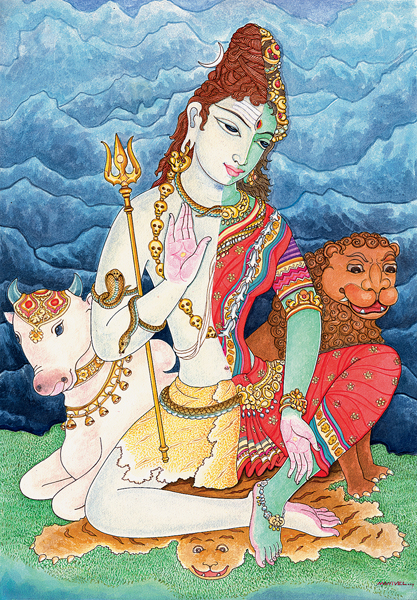
Ardhanarishvara (अर्धनारीश्वर): Shiva is represented pale skin (their right), Shakti green skin (their left).
Copyrighted to Himalayan Academy Publications, Kapaa, Kauai, Hawaii. (CC-attribution) 

The myth of Dionysus and Ariadne

Ariadne was born the princess of Crete, daughter of Minos and Pasiphaë (a sorceress), sister of the Minotaur.
The hero and future king of Athens, Theseus, embarks on a quest to end the cruel tribute Athens must pay to Crete every seven years—a sacrifice of human lives to the Minotaur, imprisoned within the labyrinth. Disguising himself among the sacrificial victims, he infiltrates the city of Knossos. There, Princess Ariadne sees him and falls in love. Moved by her feelings, she agrees to help him. She provides Theseus with a sword to slay the Minotaur and a ball of thread to navigate the labyrinth’s twisting passages. With her aid, he succeeds in his mission, and together, they flee Crete by ship.
There are different variations to this myth, but for whatever reason, Theseus abandons Ariadne on the uninhabited island of Naxos. She awakens alone and betrayed, completely hopeless. The wild wandering god Dionysus discovers the distressed Ariadne, he declares his love for her and marries her. Ariadne eventually dies (there are many versions of her death, some quite gruesome). However, Dionysus elevates Ariadne to godhood, dedicating the constellation Corona Borealis (the crown) to her. The two gods become the ultimate divine couple.

Ariadne is probably an old pre-Hellenic goddess, she is attributed as the “Mistress of the Labyrinth” in Linear B. (6) Late 19th and early 20th century scholars speculate that she is the goddess of mountains and caves. (7) Romans identified her with the goddess Libera, the wife of Liber (gods of liberty), Libera is also associated with Persephone. In Cyprus, Ariadne was worshipped as Ariadne-Aphrodite. The labyrinth itself can be seen as a kind of katabasis, a descent into the afterlife. So, Ariadne acts as a guide between life, death and renewal as she holds the thread that leads Theseus back out of the labyrinth.

A larger problem between Hindu and Hellenic myths is that Hindu myths are recorded as scripture and have few variations in the narrative. Whereas Greek mythology is recorded and retold by countless sources. That said, there is a similarity between the myths, the main one being that the future bride of both gods willingly relinquish their worldly possessions and are forced to retreat into the wilds out of love. In the case of Parvati, she gives up her life in a palace to devote herself to Shiva. With regards to Ariadne, she betrays her family and flees her luxurious life to be with the one she thinks she loves, an interpretation of her abandonment is that she is truly free when she has lost everything, and only after experiencing that loss, does Dionysus liberate her. (8)

Bacchus and Ariadne by Titian (Public Domain)

Tantric Dualism

I have already mentioned the roles that Shiva-Shakti play in Tantric philosophy, but the core of Tantric Dualism is recognising that these gods preside within us, just as all other things in the universe. These two opposing forces that complement each other exist in all matter, but for humans, it is possible that our ego can be unbalanced by one of these forces. Tantric Gurus and yogi seek to find a balance between these forces, they are to be harmonised. If a person can reach such states of harmony, they can circumvent the cycle of rebirth and be one with the cosmos. This is known as Enlightenment or reaching Nirvana.  

Dionysian Dualism

Dionysian Dualism is far less refined than Tantric, the concept was a later addition to Hellenic philosophy and did not fully develop before the rise and spread of Christianity, but it was present in beliefs in Hellenic nations of southern Italy and the Neoplatonist schools in Egypt and Greece.  

In southern Italy, they had a belief that men were Dionysus and women were Ariadne. If a person had undergone Mystery initiation the soul would ascend in union with one of these couple and become unionised as a whole and circumvent the bleakness of Hades or the cycle of rebirth.

Carl Keneryi detailed this in his book, Dionysos: Archetypical Image of Indestructible Life:
“Throughout Southern Italy the name “Ariadne” suggests itself for Dionysos’ divine partner, into whom the female deceased are transformed, while the males are transformed into Dionysos.” […] “Both sexes achieve the same Dionysian apotheosis in death.”
[…]“With such a conception of death the Dionysian religion of late antiquity diverted itself almost entirely of ethical philosophy of the Orphics. The terrors of death were overcome by the identification of the deceased man with Dionysos and by the belief that a deceased woman gave herself in love to the god.” (9)

In the third to fourth century CE, the Dionysian cult became a direct rival to the development of Christianity, which is most evident in funeral monuments and inscriptions of that period, often reserved for higher and educated classes in society. This is where we see elaborate sarcophagi, illustrating Dionysus and Ariadne, this corresponds with Kerenyi’s description. Also, in addition to this is writing detailing the elevation of the deceased to godhood. (10)

Sarcophagus featuring Dionysus and Ariadne and various seasons and nature spirits, 190-200 CE.
(The Walters Art Museum CC)

It is through the Neoplatonists that they began to view Dionysus as the “intellect of Zeus” (Dios Nous) and the Soul of the World. At this time there was a new form of henotheism, where Dionysus acts as a main god syncretizing with Apollo, Hades, Helios and Zeus (11). Dionysus becomes the link between life, death and intellect. If we extend this idea to Ariadne she plays a similar role as the divine feminine as Ariadne-Persephone-Aphrodite. Unfortunately, this is not mentioned by ancient sources instead Neoplatonists focused on the myth of Zagreus. A story where Dionysus-Zagreus is born from Zeus and Persephone, a new supreme god to control the cosmos. The jealous Hera conspired against this new god-child and released the Titans upon him, they tried to entice Zagreus with children’s toys, but it was the mirror that truly captured his attention, his own reflection. The Titans pounced upon the child and tore him apart, eating him. Zeus discovering this atrocity destroyed the Titans with his lightning bolt, and from the ashes arose humanity. (12) Here we see an essence of dualism, as under the beliefs of Neoplatonism, human beings have both the divine, ever living, Zoe of Dionysus and the corrupt, brutal Bios force of the Titans. The Titanic forces represent destruction and chaos, while the Dionysian is symbolic of the divine, creation and order.

“The myth was used not only as a symbolic narrative of the fate of the soul, but also as a metaphysical allegory of the transition between unity and multiplicity, the intelligible and the sensible world, the in divisible and the divisible, reality and its reflection”
-David Hernández de la Fuente (13)

It is also through the mirror metaphor that the Neoplatonists explore dualism and multiplicity, Macrobius alludes to the mirror in myths (Zagreus and Narcissus), for the child looking into the mirror is the “material intellect” and the reflection is the intelligible world over matter.

“Therefore, the death of Dionysus, who is divided into many pieces after seeing his reflection in the mirror, functions as an allegory for the transition from unity to the multiplicity of the material world.”
-David Hernández de la Fuente (14)

Ariadne as Dionysus’s reflection   

For the Neoplatonists, they viewed Dionysus as a whole of this duality but for the sake of this project, there will be diversion towards speculation. Ariadne is Dionysus’s counterpart, she is a mortal woman who undergoes apotheosis, but in comparison to the indefinable immortality of Dionysus (Zoe), Ariadne is feminine, material, physical and dying (Bios). Why would he fall in love with her?

The reason is backward to the feminine and masculine concepts of Tantric philosophy, that the male is destructive and the feminine is creative. In the Dionysian case, Dionysus is the creative force, while Ariadne is the destructive. Ariadne serves as the guide to the afterlife, the holder of the thread of Mystery, she is the living embodiment of Persephone, while Dionysus is the immortal explorer of death, the one at the other end of the thread venturing into the labyrinth. When Dionysus looks into the mirror he sees the face of his beloved wife. His material counterpart. As with Shiva and Parvati, Dionysus is the immaterial, the divine consciousness, while his consort is the material. When the two gods consummate they become one, two opposing forces and unite as a whole, forming the true world soul.

 If after all, Dionysus is all humanity, then he is falling in love with an aspect of himself.

Citations & Notes

1. Gods of Love and Ecstasy: The Traditions of Shiva and Dionysos, Alain Danielou, 1979

2. https://www.meer.com/en/83512-the-essence-of-tantra-exploring-duality-and-unity

3. Manu Smriti, I, 32. trans. Danielou

4. Dionysos: archetypical image of indestructible life, Carl Kerenyi, 1976

5. A complete narration of this story can be found here: https://youtu.be/T8Ifrczlqig?si=XWhMSZnXX6Xfe-nT

6. Dionysos: archetypical image of indestructible life, Carl Kerenyi, P. 90, 1976

7. This is mentioned by Evans, Kerenyi and Graves. Possibly due to Saint Ariadne of Phrygia

8. Citing Fabian’s insight from the previous course, DMC Ariadne, 2024

9. Dionysos: archetypical image of indestructible life, Carl Kerenyi, PP. 369 – 373, 1976

10. Dionysus and Politics, edited by Filip Doroszewski and Dariusz Karlowicz, Chap 11, written by David Hernández de la Fuente, 2021

11. Saturnalia, Macrobius & fragment 15 DK, Heraclitus, source: Ibid.

12. Often attributed to Olympiodorus, additional info can be found here: https://www.theoi.com/Georgikos/Zagreus.html

13. Dionysus and Politics, edited by Filip Doroszewski and Dariusz Karlowicz, Chap 11, written by David Hernández de la Fuente, 2021

14. Ibid.

Book List with Comments

A Note: This is a developing list and will be edited to include more books in the future. (Last edit: 31/07/25)

Modern Books – Academic and Pagan:

Ancient Greek Cults: A Guide by Jennifer Larson: (Larson is a modern academic who details a lot of new information regarding Greek religion, she has several books on this topic, all recommended.)

Ancient Greek Religion by Jon D. Mikalson: (This book is designed to be an easy-to-approach discussion on Greek religion.)

Greek Religion by Walter Burkert: (Burkert is a classic author who introduced Hellenic Polytheism to larger audiences. However, some of his writing is dated compared to recent studies. He has other books on Mystery cults and Orphism.)

Hellenic Polytheism: Household Worship by Christos Pandion Panopoulos and Vasilios Cheiron Tsantilas: (Aka Household Worship is a book by the religious reconstructionist organization in Greece, Labrys. A second volume will be released soon.)

Kharis: Hellenic Polytheism Explored by Sarah Kate Istra Winter: (Kharis is by a polytheist/animist, it includes both modern and ancient polytheist ideas.)

Myths, Muses and Mortals: The Way of Life in Ancient Greece by William Furley: (this book has just recently been published, it covers much of Greek life, from fashion to Mystery religion. Most topics are brief, but is a good reference and easy read.)

Old Stones, New Temples by Drew Campbell: (This book is currently out of print and can be difficult to find physically. However, it is available digitally through the Hellenion organisation.)

– Routledge: Taylor & Francis Group – a publishing house, has a series of academic books called “Gods and Heroes of the Ancient World”, each book is dedicated to a particular god or hero.

The Waters of Mnemosyne: Ancient Greek Religion for Modern Pagans by Gwendolyn Reece (I have yet to read this but it is highly recommended by my pagan peers. Reece is a pagan/polytheist writer.)

– Notable authors/academics: Fritz Graf, Karl Kerényi, Radcliffe G. Edmonds, Robert Parker (Parker’s books are notable for festivals, and miasma), Sarah Iles Johnston.

Ancient Books:

Homeric Hymns attributed to Homer, but by multiple anonymous poets: (I recommend direct modern translations.)

Greek Magical Papyri (AKA PGM: A Greco-Egyptian spell book, a translated volume 1 is currently available by Hans Dieter Betz.)

Iliad / Odyssey by Homer

The Orphic Hymns attributed to Orpheus, but by an anonymous poet/s, (recommended translations: Apostolos N. Athanassakis, Patrick Dunn, Sara L. Mastros. More info below.)

The Works and Days / Theogony by Hesiod

– There are lots of authors from antiquity that give insights into the Greek way of life, and poets with hymns, this can include Aristides, Callimachus, Herodotus, Pausanias, Pindar, Plato, Sappho etc. theoi .com often has citations and references from various authors.

Dionysian Pagan Authors:

Eleuthereus: Towards a Theology of Dionysian Liberation by Fabian MacKenzie (a unique book that explores the philosophical ideals of Dionysian Liberation Theology.)

– Dionysos: Exciter to Frenzy by Vikki Bramshaw: (Covering basic Dionysian concepts, Bramshaw approaches Dionysus from a Wicca POV, but the author relies heavily on Kerenyi and Otto.)

– Liber Dionysi by Fabian MacKenzie: (a great reference for mythology, Mackenzie’s analysis and insight on these myths are also welcomed. This book is part of a collection of self-published books.)

The God of ecstasy: Sex-roles and the madness of Dionysos by Arthur Evans: (Evans is a queer pagan activist. This book explores gender and queer roles by examining The Bacchae. How the play subverts the conventions of the patriarchy both in antiquity and modernity.)

God Who Comes, Dionysian Mysteries Reclaimed: Ancient Rituals, Cultural Conflicts, and Their Impact on Modern Religious Practices by Rosemarie Taylor-Perry: (I have not read this book, but it examines Dionysian Mysteries and plants. I am also unsure if Taylor-Perry is pagan…will edit if I am incorrect.)

Written In Wine: A Devotional Anthology For Dionysos – published by Bibliotheca Alexandrina: (As an anthology, it has multiple contributors, essays and poems.)

Dionysian Academic books:

– Dionysos by Richard Seaford: (Seaford is a modern academic, who overviews all prior writing and includes his own theories.)

– Dionysos: Archetypal Image of Indestructible Life by Carl Kerényi: (Kerenyi is a Jungian academic, though he provides a lot of insight into the history and development of the cults of Dionysus. Just keep in mind that some of Book 1, which details the Minoan way of life can be out of date.)

– Dionysus: Myth and cult by Walter Otto: (one of the early, most influential, academic books on Dionysus.)

–  There are also lots of specific books on topics regarding Dionysus like, “Dionysus and Politics” edited by Filip Doroszewski and Dariusz Karlowicz. “Gods of Love and Ecstasy: The Traditions of Shiva and Dionysus” by Alain Daniélou. “The Dionysian Gospel” by Dennis R. Macdonald.

Dionysian Hymns:

–  Homeric Hymns Hymn 7 is to Dionysus, (I prefer direct translations Penguin classics is usually okay).

–  Liber Dionysi by Fabian MacKenzie, includes old and modern translations and hymns (see notes above.)

–  The Orphic Hymns good translations include Apostolos N. Athanassakis (a direct translator), Patrick Dunn (an academic polytheist), Sara Mastros (a witch/scholar). 

Essential Dionysian Myths:

Dionysiaca by Nonnus: (is the last classical epic and is extremely long. There are two main translations: the Rouse version, which is old and open access, and “the Tales of Dionysus”  version, which is not a direct translation but modern.)

–  The Bacchae by Euripides: (I prefer direct modern translations. This play is often regarded as essential reading for Dionysians. Richard Seaford has a translation with commentary and analysis on the play.)

–  Theoi .com covers Most mythology.

Obligatory First Post

Hello and welcome to the new blog by Markos Gage – The Thyrsus.

I am a long-time writer and artist involved in the polytheist and pagan community. Previously known as The Dionysian Artist, I feel that I have outgrown that old blog and wish to restart anew.

The intention of this blog is to share my insights and offer suggestions in the exploration of the Dionysian religion and general Hellenic and Mediterranean polytheism. Here, you’ll find my free to access writing, commentary and discussions on subjects I feel are relevant towards our community.  

Thanks for reading, and may our adventures begin!